
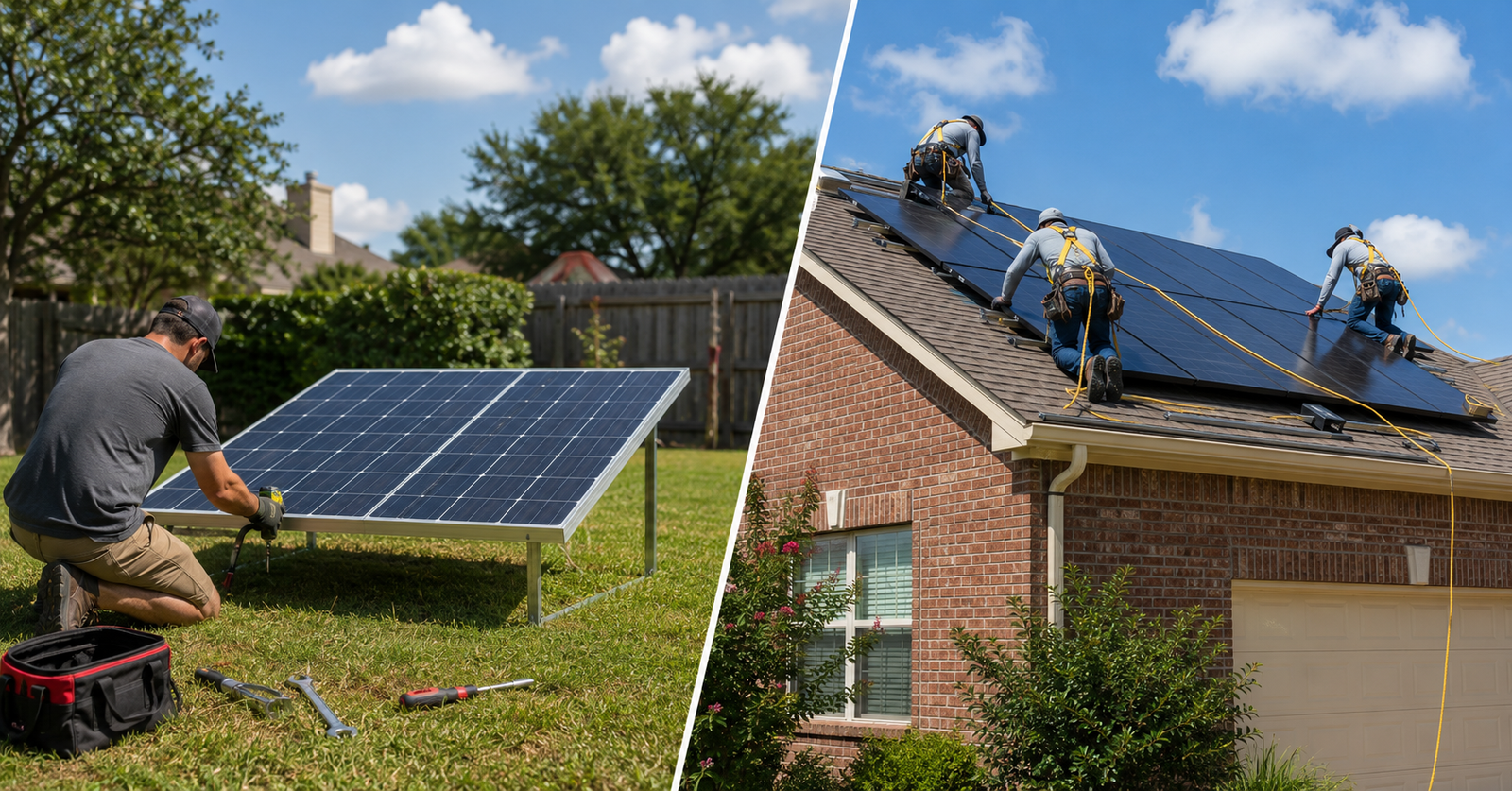
DIY solar in Texas can mean several completely different things. It might be a portable battery and folding panels that keep a refrigerator running during an outage. It might be a component-built system for a detached workshop or rural cabin. Or it might mean trying to design, permit, install, and interconnect a full residential system yourself. Those are not variations of the same project, and they do not carry the same cost, risk, or approval requirements.
DIY Solar in Texas: Three Tiers and Where Each One Makes Sense
For the statewide rules governing systems that operate in parallel with the electric grid, see the Public Utility Commission of Texas distributed-generation resources. Your utility, permitting authority, and local electrical rules may add project-specific requirements.
After seeing what a professionally installed solar-and-battery system can cost, it is perfectly reasonable to wonder how much of the work you could do yourself. The internet is full of portable solar generators, complete off-grid kits, component lists, wiring diagrams, and videos promising most of the benefit for a fraction of the price.
I understand the appeal. I work as an electrical designer on utility-scale PV and battery-storage projects, and I still hired a professional installer for the system at my own house.
That was not because every form of DIY solar is foolish or illegal. Some DIY and plug-and-play systems are genuinely useful. The problem is that people use the phrase “DIY solar” for products and projects that have almost nothing in common.
Keeping a refrigerator and Aunj’s CPAP running from a portable battery is one kind of project. Building an isolated system for a detached workshop is another. Connecting a rooftop array and batteries to the main electrical service, operating them in parallel with the utility, and configuring automatic whole-house backup is an entirely different level of work.
Here is where each approach makes sense and where the simple version stops being simple.
Three Very Different Things People Call DIY Solar
Portable Power Stations
A packaged battery, inverter, charger, and outlets paired with portable solar panels. Useful for selected appliances, electronics, camping, and short-term outage backup.
Component-Built Systems
You select and assemble the panels, batteries, inverter, protection devices, wiring, controls, and mounting equipment. Common in RV, marine, cabin, workshop, and off-grid projects.
Permitted Grid-Tied Systems
A permanently installed system connected to the home and approved for parallel operation with the utility. It may include solar, batteries, automatic backup equipment, and export capability.
The dividing line is not whether the box says “DIY.” The real questions are whether the equipment is permanently connected to the building, whether it can energize household wiring, whether it operates in parallel with the utility, and which permits, inspections, and approvals apply where you live.
When a Portable Power Station Makes Sense
A portable power station is often the easiest way to buy meaningful outage protection without turning the project into a permanent home installation. The battery, inverter, charging equipment, controls, and receptacles are packaged together. You can charge it from the wall, compatible solar panels, or another approved source and then plug selected loads directly into it.
For a basic outage setup, that may be enough to keep a refrigerator cold, charge phones and laptops, operate lights and fans, and run a CPAP. You do not need a rooftop array or utility export agreement just to use the unit through its own factory outlets.
The tradeoff is that you still have to decide which loads matter. With a basic portable setup, that usually means moving cords, unplugging equipment, monitoring the battery level, and avoiding combinations of loads that exceed the inverter’s output.
Do not confuse portable with unlimited. A power station may have enough output to start a large appliance but not enough stored energy to run it for long. Power output determines what can operate at the same time. Battery capacity helps determine how long those loads can run.
| Usually a Good Match | Requires Careful Sizing or Integration |
|---|---|
| Phones, laptops, and internet equipment | Central air conditioning |
| LED lighting and fans | Electric water heating |
| CPAP and other modest medical loads | Electric ranges and ovens |
| Refrigerator or freezer | Electric clothes dryers |
| Small tools and electronics | Multiple large household loads at once |
Some larger portable systems offer 240-volt output, expansion batteries, transfer equipment, or home-integration accessories. At that point, the answer depends on the exact equipment and how it is connected. Once the system feeds household circuits instead of stand-alone appliances, it is no longer enough to say that it simply “plugs in.”
When DIY Solar Becomes a Permanent Electrical Project
A component-built system becomes much more serious when it is permanently mounted, connected to household circuits, tied into the service equipment, or capable of operating in parallel with the utility.
The electrical design
A residential solar-and-battery installation can involve high DC voltage, substantial fault current, multiple sources of power, grounding and bonding, conductor sizing, overcurrent protection, disconnecting means, labeling, rapid shutdown, arc-fault protection, battery requirements, and coordination with the existing service equipment.
The danger is not limited to touching a live conductor. A connection can appear to work while still having improper protection, inadequate conductor ampacity, poor terminations, incompatible equipment, or an unsafe shutdown arrangement. Those problems may not become obvious until the system is heavily loaded or something fails.
Licensing and local permits
Texas generally requires people performing nonexempt electrical work for the public to be licensed and to work through a licensed electrical contractor. Texas also recognizes a state licensing exemption for a person performing electrical work on a dwelling that person owns and occupies.
That exemption is not a statewide promise that every homeowner can install any solar system without oversight. Municipal or regional rules can override state exemptions, and the local permitting authority may require plans, inspections, contractor registration, engineering documents, or licensed participation before approving the work.
Utility interconnection
If the system will operate in parallel with the utility, you must follow the serving utility’s interconnection process. That generally includes an application, equipment and design information, an interconnection agreement, and utility approval before normal parallel operation begins.
CenterPoint, Oncor, and other Texas utilities maintain their own submission processes and project requirements. Oncor, for example, requests equipment details, one-line documentation, layout information, disconnect information, and required placarding for residential distributed-generation projects. CenterPoint likewise requires an application for interconnection and parallel operation.
Do not connect a generating system to household wiring in a way that can backfeed the utility without approved interconnection and isolation equipment. A grid-connected system must not energize utility lines during an outage. The utility may refuse connection or disconnect an unapproved generating facility operating in parallel with its system.
So, can a homeowner participate in a DIY grid-tied project? Potentially, depending on the property, jurisdiction, utility, permit rules, homeowner exemption, equipment, and which portions of the work are performed by licensed professionals. That is very different from ordering a kit on Friday and connecting it to the main panel on Saturday.
Where Component DIY Solar Can Make the Most Sense
A stand-alone system can be a good DIY project when it serves a clearly defined load and never operates in parallel with the utility.
Examples include a remote cabin, RV, boat, shed, gate, well pump, communications equipment, or a detached workshop where extending utility service would be expensive. In those cases, you can size the panels, storage, and inverter around a limited group of loads instead of trying to duplicate an entire residential electrical service.
Not being connected to the utility removes the utility-interconnection process, but it does not remove the need for safe design. A permanent off-grid system may still be subject to the electrical code, building permits, zoning rules, fire requirements, equipment listings, structural requirements, and inspection by the local authority.
The system also has to survive periods when the solar resource does not match the load. A cabin that works beautifully on a clear April weekend may behave very differently during several cloudy winter days. The design needs enough generation, storage, load control, or backup charging to cover the conditions you actually expect.
Component platforms from companies such as Renogy, EG4, and Victron are commonly considered for these projects, but the brand name does not design the system for you. You still have to confirm voltage compatibility, battery communication, protective-device ratings, conductor requirements, operating temperatures, enclosure ratings, and whether the equipment is listed and accepted for the intended installation.
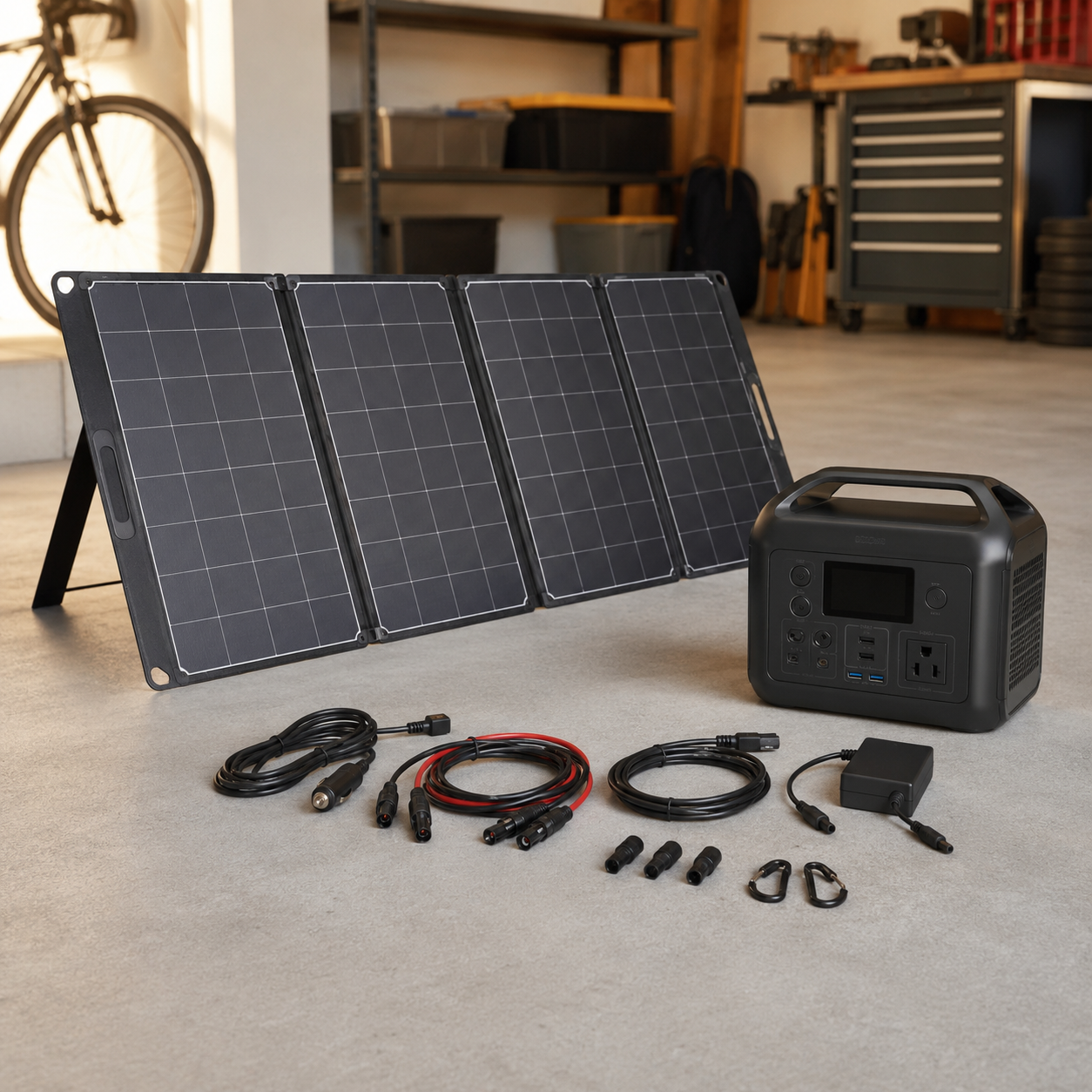
A packaged portable kit keeps the battery, inverter, and connections inside factory-built equipment. A component-built system makes you responsible for every one of those decisions instead.
Why I Hired a Professional Installer for My Own House
I understand solar and battery design well enough to know where the project stops being a collection of components and becomes part of the house’s electrical infrastructure.
For our home, I wanted a 10.53 kW rooftop array, two Tesla Powerwall 3 units, automatic backup operation, and the entire house connected to the backup arrangement. I wanted the system permitted, inspected, documented, and approved to operate in parallel with CenterPoint’s grid.
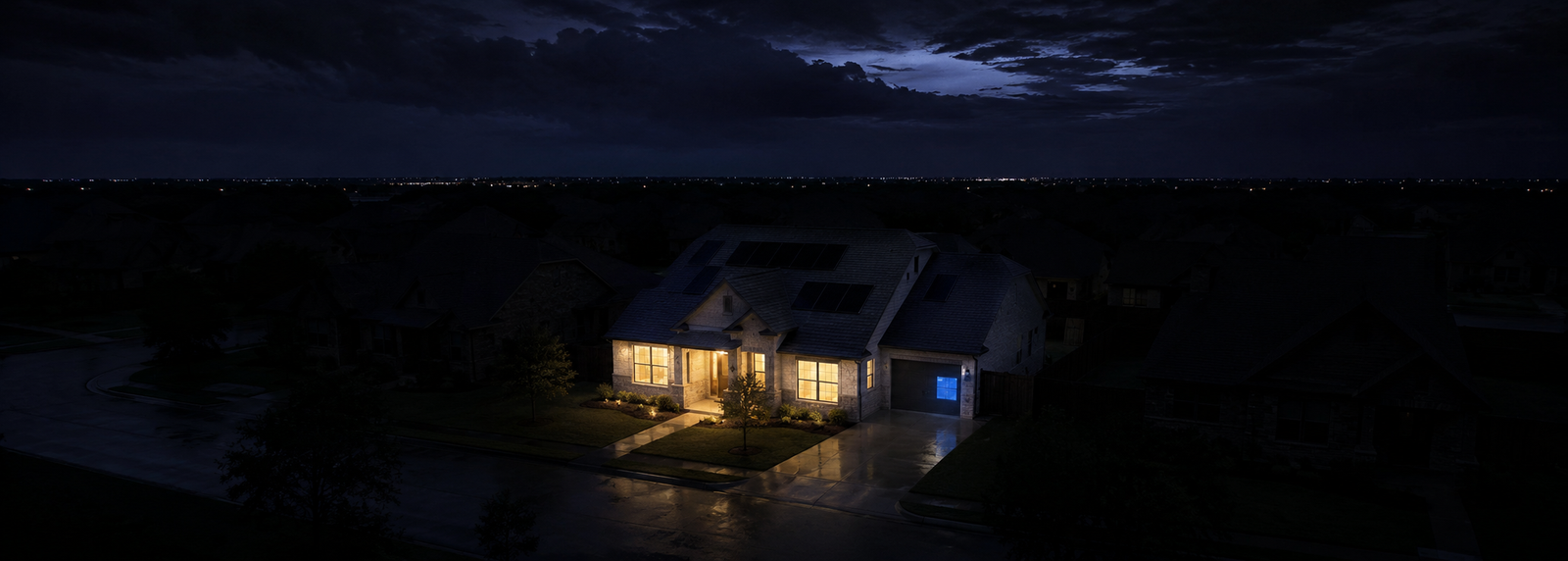
I also did not want Aunj hunting for extension cords during the next outage so she could use her CPAP. After Hurricane Beryl left our neighborhood without power for five days, automatic backup was not a decorative feature. It was one of the main reasons we installed the system.
Whole-house backup still has limits. It means the house is connected to the backup system. It does not mean every major load can run at once or that 27 kWh of nominal battery storage will last indefinitely. Battery output determines what the system can support simultaneously, while stored energy and actual household use help determine runtime.
I could have purchased components myself and tried to coordinate portions of the work. I hired Good Faith Energy because I wanted one company responsible for the design, equipment, roof installation, electrical work, permits, inspection coordination, interconnection process, commissioning, and final operation.
Their initial proposal was around $35,000. I then worked with the engineering team to expand the system beyond that first design, bringing the final signed contract to $44,395. That was not the cheapest possible route. It was the route that matched what I wanted the finished system to do.
| Your Main Goal | Approach Worth Considering |
|---|---|
| Run a refrigerator, CPAP, lights, and electronics during an outage | Portable power station sized to those loads |
| Power an isolated cabin, RV, shed, or workshop | Stand-alone component system |
| Reduce grid use without exporting power | Professionally reviewed zero-export or self-consumption design |
| Operate in parallel with the utility or export electricity | Permitted system with approved utility interconnection |
| Automatically back up household circuits or the entire home | Integrated solar-and-storage design based on actual loads |
Looking for More Than a Portable Outage Battery?
Good Faith Energy installed the solar and battery system at my own home. Their initial proposal was substantially lower than the first door-to-door offer I received. I later worked with their engineering team to expand the design into the 10.53 kW array and two-Powerwall system we ultimately purchased.
A professionally installed system is not automatically the right answer for every goal. But when the project involves rooftop attachments, permanent electrical connections, automatic backup, permits, inspections, and utility interconnection, I wanted one company responsible for getting those parts to work together.
I hired Good Faith Energy for my own home before joining its referral program. If you request a quote through my link and later complete a qualifying installation, I may receive a commission.
Request a Quote from Good Faith EnergyWant to Learn the Design Side First?
If any part of this page made you want to understand the engineering before you buy equipment or talk to anyone, that is the right instinct. Sean White has written some of the most widely used books on solar design, installation, and energy storage. They are written for industry professionals, but they are exactly what a serious DIY reader needs to understand what a safe, code-compliant system actually involves.
Solar Photovoltaic Basics
The starting point. If you are deciding between a portable kit, a component build, or a professional system, this explains what you are actually buying.
View on AmazonSolar PV Engineering and Installation
The book for the component-build reader. Conductor sizing, protection, grounding, and the design decisions that Block-by-block kits leave up to you.
View on AmazonEnergy Storage Basics
Covers battery systems, including the whole-house backup arrangement described on this page. Useful whether you build or hire.
View on AmazonBrowse All Sean White Solar Books on Amazon
As an Amazon Associate, I earn from qualifying purchases made through these links.

Affiliate disclosure: This page contains a referral link to Good Faith Energy and Amazon affiliate links. If you request a quote through the Good Faith Energy link and later complete a qualifying installation, I may receive a commission. As an Amazon Associate, I earn from qualifying purchases. I hired Good Faith Energy for my own home before joining its referral program. All opinions are my own. Product names are included as examples, not as blanket endorsements. Electrical licensing exemptions, permit requirements, adopted codes, utility-interconnection rules, and approved equipment vary by location and project. Verify the current requirements with your local permitting authority, serving utility, insurance company, and qualified electrical professionals before purchasing or connecting a system.