Texas solar financing comes in two forms: low-interest loans with hidden dealer fees that inflate your principal by 20 to 40 percent, and straightforward loans from local lenders where the amount you borrow matches the actual cost of the system.
Texas Solar Financing: Why the Interest Rate Is Not the Number That Matters
For more detail on how these fees work and what regulators have said about them, see the CFPB Issue Spotlight on Solar Financing.
I design utility-scale solar and battery-storage systems for a living. When I bought a residential solar and battery system for my own house, I did not judge the proposals by the equipment list or monthly payment alone.
I looked at the math.
The first door-to-door proposal I received exceeded $70,000. The contract I eventually signed with Good Faith Energy was $44,395.
Both proposals were intended to serve the same basic goal: solar production, battery storage, and meaningful backup power for my house. They were not necessarily identical line for line, so I am not going to pretend that financing explained every dollar of the difference.
But financing costs, sales commissions, lender charges, dealer fees, and other markups can completely change what a homeowner pays. That is the lesson. The interest rate is not the first number I would examine on a solar loan. The principal is.
The Hidden Cost Inside Some Low-Interest Solar Loans
A solar lender may advertise an interest rate that looks far below the normal market rate. That does not necessarily mean the homeowner is getting unusually inexpensive financing.
In some solar-specific loans, the low rate is purchased through a large upfront charge built into the transaction. Within the industry, that charge may be called a dealer fee, program fee, platform fee, finance fee, lending fee, or original-issue discount.
The CFPB has warned that some of these fees increase the loan principal by 30 percent or more above the cash price. In some cases, the markup can exceed 50 percent.
The homeowner may never see a line on the proposal labeled “dealer fee.” Instead, the financed price is simply much higher than the amount the installer would accept in cash.
Imagine a solar system with a cash price of $30,000. If the financed contract price becomes $39,000 in exchange for a reduced interest rate, the homeowner begins the loan owing $9,000 more than the cash buyer would have paid. Interest is then calculated on that larger balance. That does not automatically mean every low-rate loan is a bad deal. It means the homeowner cannot evaluate the loan by only looking at the interest rate.
The Numbers Every Solar Quote Should Show
Before agreeing to solar financing, ask for the following in writing.
| Number to Request | Why It Matters |
|---|---|
| Cash price | The price of the complete system if you purchase without the installer’s financing. It should cover the same equipment and scope as the financed proposal. |
| Financed contract price | The price being financed before loan interest accumulates. It may appear as the sale price, contract price, or principal amount. |
| Amount financed | The amount of credit actually extended under the loan disclosures. Loan charges and prepaid finance costs can affect how this is reported. |
| Interest rate | The percentage used to calculate interest on the outstanding balance. It does not include every possible cost of borrowing. |
| APR | APR is intended to reflect the cost of credit more broadly, but it may not reveal a markup embedded in the installer’s sale price. |
| Total of payments | How much you are scheduled to pay over the life of the loan. A manageable monthly payment can still produce a very high total over 20 or 25 years. |
How to Find the Markup
Ask the installer to provide the cash and financed prices for the exact same equipment and scope. Then ask them to explain every difference in writing. If the installer refuses to provide a same-scope cash price, that tells me something. I would not sign.
A homeowner should not label every dollar of difference between the cash price and the financed price as a dealer fee without seeing the full breakdown. The difference may include loan fees, rate-buydown costs, different system scope, additional warranties, or other financed charges. The installer should be able to explain every part of the difference.
Why Early Payoff Changes the Math
A large upfront markup is especially costly when the homeowner expects to sell, refinance, or pay the loan off early.
Suppose you accepted a higher principal in exchange for a low interest rate. If you keep the loan for its entire term, the reduced rate may offset part of the upfront markup. Whether that happens depends on the actual numbers.
But if you pay the loan off after only a few years, you may not keep it long enough to receive the full benefit of the lower rate. The markup was added on day one.
That is why the right question is not, “Which loan has the lowest monthly payment?” It is, “Which loan produces the lowest total cost based on the way I realistically expect to repay it?”
Ask the lender to show you the estimated payoff amount after one year, five years, ten years, and at the end of the full term. That reveals the difference between a loan designed to look inexpensive and one that is actually economical for your plans.
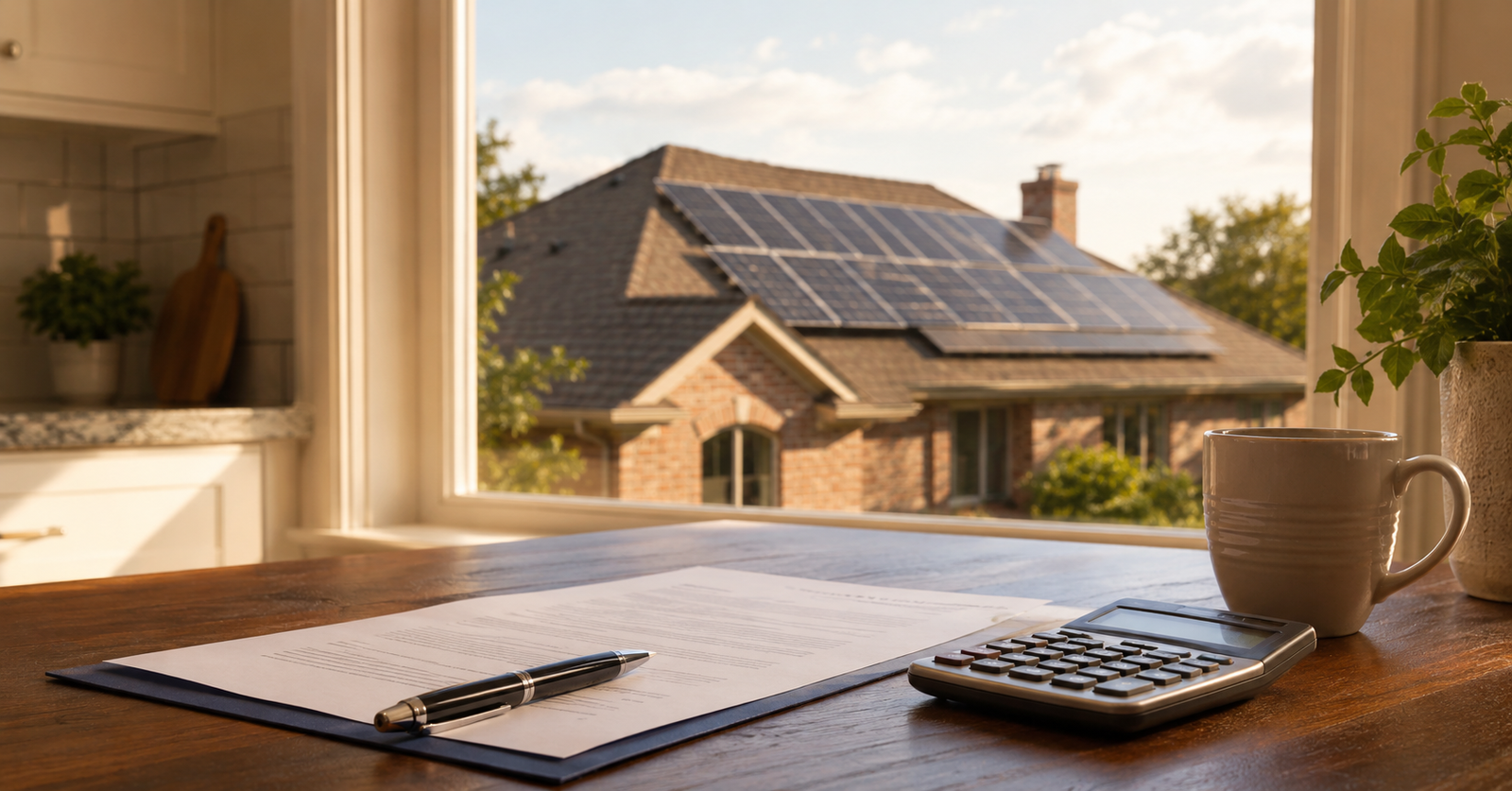
The monthly payment printed in the largest type is not the number that determines whether a solar loan is a good deal.
How My Financing Worked
Good Faith Energy connected me with a credit union based in the San Antonio area. They also had another financing option available if the credit union loan did not work.
My signed system price was $44,395. The loan had a 20-year term and an 8.49 percent interest rate. The rate was higher than the unusually low rates often advertised for solar loans, but I was not starting with the kind of large upfront markup I had been trying to avoid. That mattered to me more than seeing a 1.99 percent rate printed in large type.
My financing was structured around the federal residential clean-energy credit available when my system was installed in 2024. If I had not applied the anticipated tax-credit amount to the principal, the payment would have been approximately $400 per month. Applying that amount to the loan as planned reduced the scheduled payment to approximately $280. With the way the loan is currently being paid, my normal monthly payment is approximately $300.
That is my transaction. It is not a statement that every credit union offers fee-free solar loans or that Good Faith Energy offers the same financing today. Lenders, rates, fees, and available programs change. Anyone comparing proposals today should request the actual cash price, financed price, APR, loan term, total repayment, prepayment terms, and any payment-reset provisions.
The Former Federal Tax-Credit Payment Trap
When I installed my system in 2024, homeowners with qualifying residential solar and battery installations could claim a federal residential clean-energy credit. Many solar loans offered during that period assumed that the homeowner would make an early principal payment equal to roughly 30 percent of the project price.
A salesperson might show a lower monthly payment based on the assumption that the homeowner would claim the tax credit and send that money to the lender. If the expected principal payment was not made by the stated deadline, the monthly loan payment could increase.
That created several problems. The credit was not an instant rebate. It was a nonrefundable federal income-tax credit subject to eligibility requirements and the homeowner’s tax situation. A homeowner might have less federal tax liability than expected, receive the benefit over more than one tax year, or misunderstand when the money would become available.
For systems placed in service after December 31, 2025, the federal residential clean-energy credit is no longer available. A salesperson presenting a new 2026 proposal should not use the expired 30 percent federal credit to make the monthly payment appear lower. If a salesperson is still using this credit to show a reduced payment on a new system, ask to see the IRS documentation supporting it.
My Current Fixed Monthly Solar Costs
I am not claiming that another homeowner will receive my pricing, bill results, or electric plan. This is where I landed.
| Item | Monthly Amount |
|---|---|
| Solar and battery loan payment | ~$300 |
| Utility base charge | ~$10 |
| Total fixed monthly baseline | ~$310 |
My highest pre-solar electric bill reached approximately $450. The specific TXU summer bill used in my documented year-to-year comparison was $376.10. Those numbers describe two different things and should not be blended together.
Most months, the variable energy portion of my current bill has been small or offset by account credits. Some high-demand summer months still result in additional grid charges. This is not a claim that solar eliminated my electric bill. The benefit, for me, has been greater cost stability. I replaced a large, unpredictable utility expense with a more predictable baseline that also pays for the solar array and two Powerwall 3 batteries installed at my house.
Questions to Ask Before Signing a Solar Loan
Get written answers to all of these questions before you sign anything.
- What is the cash price for this exact system and scope?
- What is the financed contract price?
- What is the actual loan principal or amount financed?
- Why is the financed price different from the cash price?
- Is there a dealer fee, program fee, platform fee, origination fee, or rate-buydown charge?
- What is the stated interest rate?
- What is the APR?
- How long is the loan term?
- What is the total of all scheduled payments?
- Is the quoted monthly payment temporary or permanent?
- Does the payment assume a future lump-sum payment?
- What happens if that lump-sum payment is not made?
- Is there a prepayment penalty?
- What would the payoff amount be after one, five, and ten years?
- What property, if any, secures the loan?
- What happens to the loan if the house is sold?
- Can I obtain independent financing and still receive the same cash price?
Do not let the conversation stop with, “Your payment will only be $249 per month.” That number tells you almost nothing by itself.
My Bottom Line
A solar loan is not automatically good because the interest rate is low. It is not automatically bad because the rate is higher.
The right questions are what you are buying, how much you are borrowing, which costs were added before interest, how the payment may change, and what the loan will cost based on the way you realistically expect to repay it.
My first proposal exceeded $70,000. The contract I signed was $44,395. The lesson was not that every solar installer charges the same cash price or that every credit union offers the best loan. The lesson was that I refused to judge a 20-year financial commitment by the monthly payment printed in the largest type.
Demand the cash price. Read the loan disclosures. Compare the total cost. Then decide whether the system still makes sense.
Want a Second Solar Proposal to Compare?
Good Faith Energy installed the solar and battery system at my own house. Their proposal was substantially more reasonable than the first door-to-door offer I received, and their financing option worked for my situation.
Request the cash price along with any financing options, then compare their proposal with the others you receive.
Referral disclosure: I may earn a commission if you request a quote through my link and later become a customer. I hired Good Faith Energy for my own house before entering into the referral relationship.
Request a Quote from Good Faith EnergyMore Pages in This Series


The prices, rates, loan terms, payments, utility charges, and tax treatment described here relate to my own transaction completed in 2024. Financing programs and electric plans change. The federal residential clean-energy credit described on this page was available for systems placed in service on or before December 31, 2025. It is not available for systems placed in service after that date. This page is for educational purposes only and is not financial, legal, or tax advice. Review the lender’s disclosures and consult qualified financial and tax professionals before signing a long-term loan.