

What a $70,000 proposal taught me about residential solar sales
This is a Texas solar sales warning from someone who designs PV and battery-storage systems for a living. If you own a house in Texas, there is a good chance someone has knocked on your door offering solar with no money down, a lower electric bill, and protection from the next outage.
The presentation can be convincing. The representative who came to my house was polished, knew the right answers, and understood how to make the offer sound simple. I work in PV and battery-storage design, and even I could see why homeowners would sign.
Then I saw the proposal.
It was more than $70,000, and the numbers did not support the price. I later received an initial proposal from Good Faith Energy for roughly $35,000. After working directly with their engineering team, I expanded the system beyond the initial sales-style design, and my final signed contract was $44,395.
That gap is why I started looking more closely at how residential solar is sold, financed, and described.
This is not an argument against solar. I installed a 10.53 kW array with two Tesla Powerwall 3 units at my own home. It is a warning not to confuse a smooth sales presentation with a complete system design.
“Zero Down” Does Not Mean Low Cost
Zero down usually means you are financing the full project rather than paying cash at installation. It tells you when the first dollar leaves your account. It does not tell you what the system costs.
Some solar-specific loans include dealer fees or other finance charges in the loan principal. Those fees can make the financed price substantially higher than the cash price, especially when the loan advertises an unusually low interest rate.
The monthly payment can still look attractive because the cost is spread across a long term. That is why the salesperson may keep returning to one number: “This payment is lower than your electric bill.”
Do not compare only the payment. Ask for:
- The complete cash price
- The complete financed price
- The loan principal
- The interest rate and APR
- The loan term
- Every dealer, finance, origination, or program fee
- The total amount paid if you make every scheduled payment
- Whether the payment changes if you do not make an expected early principal payment
A low monthly payment can be useful. It can also hide an expensive contract.

The monthly payment is one number. The total cost of the contract is another.
“Whole-House Backup” Needs a Real Definition
This was one of the most important issues for me. I was not buying solar merely to reduce an electric bill. I wanted the house to remain usable when the grid failed.
Sales language around backup can be loose. “Battery backup,” “whole-home capable,” and “keeps your house running” do not necessarily describe the same system.
A proposal may back up only a critical-load panel containing selected lights, outlets, refrigeration, internet equipment, and perhaps medical equipment. Central air conditioning, electric water heating, cooking equipment, dryers, pumps, or EV charging may be excluded.
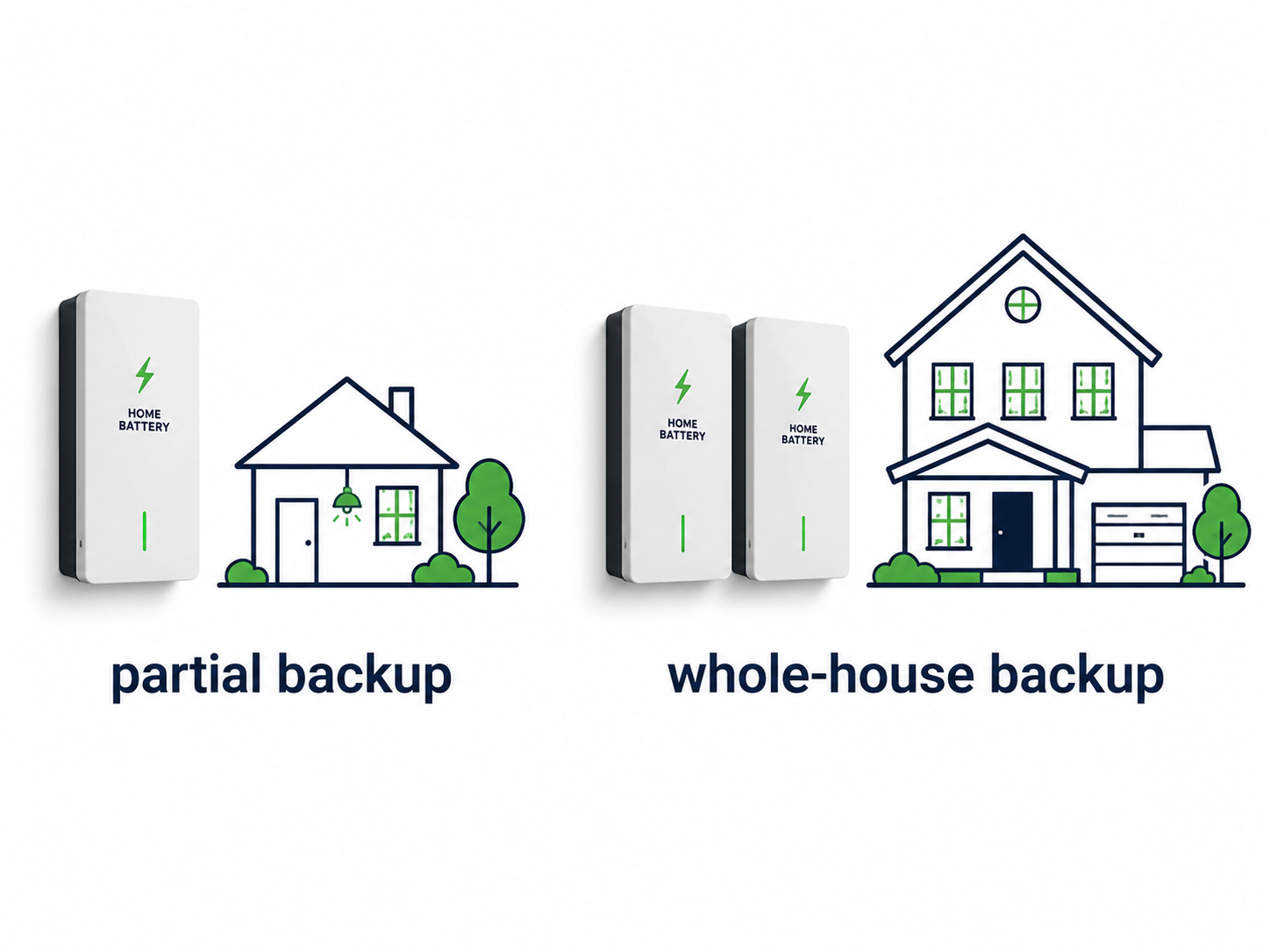
One battery and one backed-up panel are not the same thing as whole-house backup.
A single battery is not automatically inadequate, and multiple batteries do not automatically guarantee whole-house performance. The answer depends on:
- The battery and inverter output
- The amount of stored energy
- The starting and running demand of the air conditioner
- The electrical-service configuration
- Which circuits are connected to backup
- Whether large loads are controlled or shed automatically
- How much solar production is available to recharge the batteries
When I say our system provides whole-house backup, I mean the backed-up electrical arrangement serves the entire house rather than a small emergency panel. We can operate the central air conditioner, kitchen refrigerator, garage freezer, lights, and normal household circuits.
That does not mean we can run every heavy appliance indefinitely. Whole-house access is not unlimited energy.
Ask the installer to identify every backed-up circuit and show you the power and energy calculations behind the claim. Do not accept “the battery can run your house” as a complete system design.
My $70,000 Reality Check
The first salesman who came to my house knew what he was doing. His presentation was polished. He had answers ready. He said the things a homeowner wants to hear when electric bills are climbing and the grid keeps failing.
Then he handed me a proposal for more than $70,000.
I work in PV and battery-storage design. I understand that equipment, labor, engineering, permitting, batteries, and electrical work cost money. I was not expecting a bargain-bin system. But I also knew enough to see that the price did not match the system being offered.
I later contacted Good Faith Energy through someone I trusted in the industry. They surveyed the house, reviewed our usage, and provided an initial proposal for about $35,000.
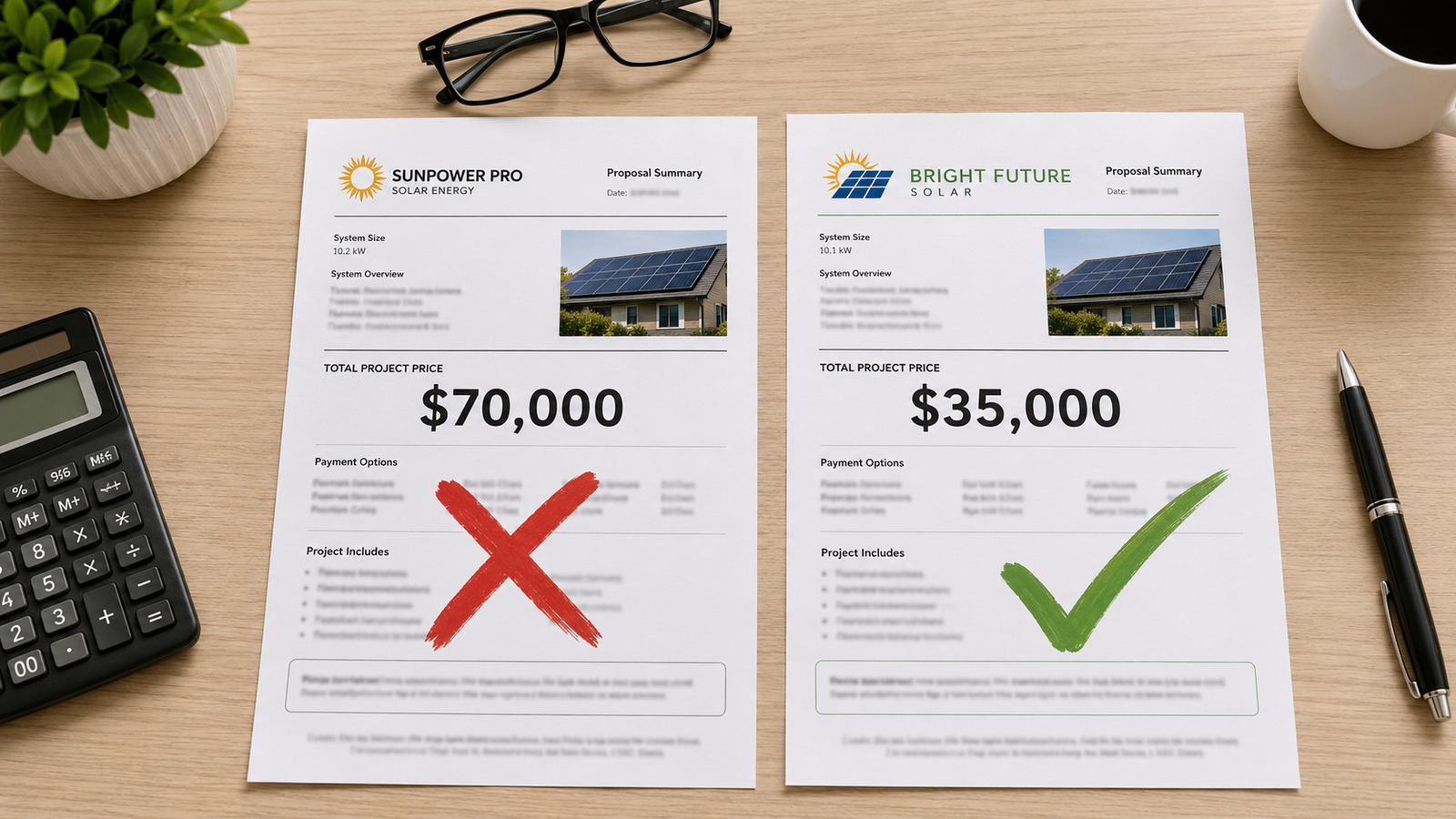
The initial proposals were intended to serve the same basic goal, but one was roughly twice the price.
The initial proposals were not necessarily identical line for line, so I am not claiming that every dollar of the difference came from sales commissions or financing. What the comparison showed me was that the first price could not be justified by the equipment and scope being offered.
I then worked directly with Good Faith Energy’s engineering team and deliberately expanded the system beyond their initial sales-style proposal. My final signed contract was $44,395 for a 10.53 kW array and two Powerwall 3 batteries.
Even after expanding the system, the final contract remained substantially below the original door-to-door offer.
That experience changed the way I look at residential solar sales. The equipment matters, but so does the path the contract takes before it reaches the homeowner. Sales commissions, marketing layers, lender fees, and outside financing costs can all be hidden inside one clean monthly payment.
That is why I tell people to compare the cash price first. Strip away the loan term, tax-credit assumptions, and monthly-payment pitch. Find out what the system itself actually costs.
Several layers can affect the final contract price:
- Equipment and installation costs
- Sales compensation
- Marketing-company margins
- Dealer or lender fees
- Roofing or electrical work
- Battery configuration
- Warranty and service obligations
- Financing terms and interest structure
Compare more than the panel count. Put the cash price, financed price, array size, battery quantity, inverter capacity, backup scope, warranties, roof work, and expected production side by side.
Do Not Let the Tax Credit Do the Selling
Solar salespeople have used the federal tax credit for years to make the price look smaller than the contract a homeowner is actually signing.
For qualifying residential systems completed through the end of 2025, the federal credit was generally 30 percent of eligible costs. It was not a guaranteed rebate check. It reduced the federal income tax owed, and the amount a homeowner could use depended on their individual tax situation.
That matters because some solar loans were structured around the assumption that the homeowner would use the tax benefit to make a large payment toward the loan within the first year or so. If that payment was not made, the monthly loan payment increased.
For new systems installed after December 31, 2025, the former federal residential credit is no longer available under current law. If someone is still subtracting 30 percent from a 2026 proposal, ask them to show you exactly which current program they are using.
Before signing, ask for three numbers in writing:
- The actual contract price
- The loan amount before any assumed tax benefit
- The monthly payment if you never make the expected lump-sum payment
The salesperson can explain the proposal. A qualified tax professional should explain whether you personally qualify for any tax benefit.
What I Would Do Before Signing Anything
I would not sign a solar contract at the front door. I do not care how friendly the representative is, how good the payment sounds, or how urgent the promotion appears.
Take the proposal. Close the door. Read it when nobody is standing over you waiting for an answer.
Then get at least two more quotes and make sure you are comparing the same system. One proposal may include batteries, service upgrades, roofing, or whole-house backup, while another quietly leaves those items out.
Ask for the cash price and financed price separately. That one question can expose tens of thousands of dollars in financing costs and dealer fees.
Ask who will actually install the system. The person at your door may work for a sales company that never touches a panel, pulls a permit, or answers a service call.
Most importantly, ask exactly what happens when the grid goes down.
Do not accept, “The battery will run the house.” Ask whether the central air conditioner is included. Ask which circuits are backed up. Ask how much power the batteries can provide, how much energy they store, and what happens after a cloudy day.
If the answers become vague when the questions become specific, stop.
The Questions I Would Ask at My Own Door
- What is the cash price?
- What is the financed price?
- How much of the loan consists of financing charges or dealer fees?
- Who is the lender?
- Who is the licensed installer?
- Will the installer use employees or subcontractors?
- What is the array size in kW DC?
- What inverter output is available?
- How many kilowatt-hours of battery storage are included?
- Does the system provide whole-home or partial-home backup?
- Is central air conditioning included in the backup plan?
- Which circuits are not backed up?
- What happens if I do not receive an expected incentive?
- Does the monthly payment change later?
- What happens when the roof needs to be replaced?
- Who handles warranty service after installation?
If the answers become vague as the questions become specific, slow the process down.
Want Another Proposal to Compare?
Good Faith Energy designed and installed the solar and battery system at my own home. Their initial proposal was roughly half the price of the first door-to-door offer. I later worked directly with their engineering team to expand the system, bringing my final signed contract to $44,395.
That does not mean you should stop comparing. Ask them for the same details you would demand from anyone else: the cash price, financed price, equipment list, production assumptions, backup scope, warranties, and loan terms.
Request a Quote from Good Faith EnergyReferral disclosure: I may earn a commission if you request a quote through this link and later become a customer. I hired Good Faith Energy for my own house before entering the referral relationship.
More From the Solar Section

Disclaimer: I am an electrical designer, not a licensed financial advisor, tax professional, or attorney. Nothing on this page should be considered financial, tax, or legal advice. Solar system performance, pricing, and incentive eligibility vary by location, equipment, installer, and individual tax situation. Consult qualified professionals before making a purchasing or financial decision.
Affiliate disclosure: This page contains affiliate links. If you request a quote from Good Faith Energy through a link on this page and later become a customer, I may earn a referral commission at no additional cost to you. I hired Good Faith Energy to install the solar and battery system at my own home before entering the referral relationship. All opinions are my own.