
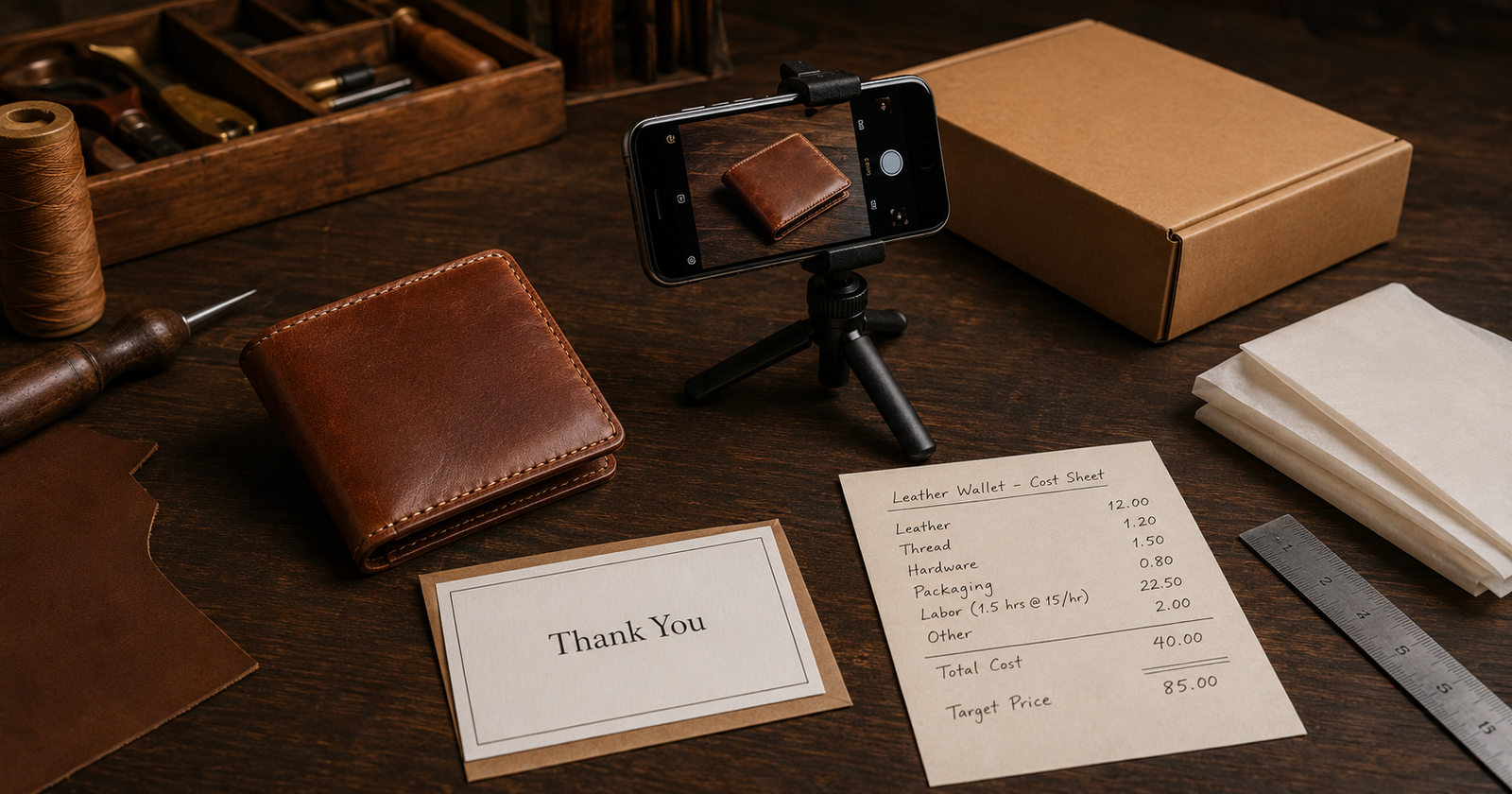
The Practical Business of Leathercraft
At some point, many leatherworkers run out of friends and relatives who need another wallet. That is usually when the idea of selling leather goods online starts feeling real.
Selling changes the work. A small mistake you would ignore on your own belt may become a return. A project that feels relaxing when made once can become exhausting when five customers order it in the same week. Even packaging, photography, messages, and trips to the post office become part of the product.
The first goal is not to build a huge catalog. It is to choose a small number of products you can make consistently, calculate what they truly cost, present them clearly, and learn what customers respond to before tying up money in inventory.
This guide covers the practical basics of pricing, product photography, listings, production, materials, and preparing your first leather goods for sale.
Start with Products You Can Repeat
A good first product is not merely something you enjoyed making once. It is something you can make again with reasonably consistent time, quality, materials, and measurements.
Start with a small group of products that share tools, leather, hardware, and construction methods. A card wallet, keychain, belt keeper, and simple bifold may be easier to manage together than a catalog containing bags, armor, dog collars, notebook covers, and custom holsters.
Time the complete job
Track more than cutting and stitching. Include pattern layout, edge work, hardware setting, finishing, cleanup, photography, packaging, customer messages, and shipping preparation.
The first version will usually take longer than later copies, but do not price from an imaginary future speed you have not reached yet. Use your actual working time, then improve the process as orders teach you where time is being lost.
Decide what can be customized
Every color, thread, hardware, size, monogram, and layout option creates another decision and another opportunity for error. Offer enough choice to make the product attractive without turning every order into a brand-new design project.
Calculate the Real Cost of Your Work
The practical rule: A price should cover the full cost of making and selling the item, pay for your time, and leave enough profit to keep the business operating.
Do not price a handmade leather item by comparing it only with a department-store product. The materials, production volume, labor, equipment, and selling costs are completely different.
Start by calculating these categories:
- Direct materials: Leather, thread, hardware, lining, adhesives, finish, and packaging used for that item.
- Material waste: Offcuts, defects, failed pieces, test cuts, and the unused area around patterns.
- Labor: All hands-on production time, not just stitching.
- Selling costs: Marketplace charges, payment processing, advertising, discounts, and expected returns or replacements.
- Overhead: Tools, blades, shop supplies, equipment wear, website costs, photography equipment, utilities, and workspace expenses.
- Profit: Money left after the costs and labor have been paid.
A multiplier such as doubling cost can be useful as a quick check, but it should not be treated as a universal pricing formula. It may work for one product and badly underprice or overprice another.
A simple working example
Suppose a wallet uses $18 in leather, hardware, thread, finish, and packaging. You allow another $4 for waste and consumables. It takes two hours to complete, and you value that production time at $22 per hour.
- Materials and packaging: $18
- Waste and consumables: $4
- Labor: $44
- Current production cost before overhead and selling fees: $66
The final selling price still needs to cover overhead, platform or payment costs, and profit. That may produce a price the market will not accept. When that happens, the answer is not always cheaper leather. You may need to simplify the construction, improve the workflow, change the design, target a different buyer, or stop selling that particular product.
Bench note: Your labor is a cost. Profit is what remains after paying that labor and the other expenses.
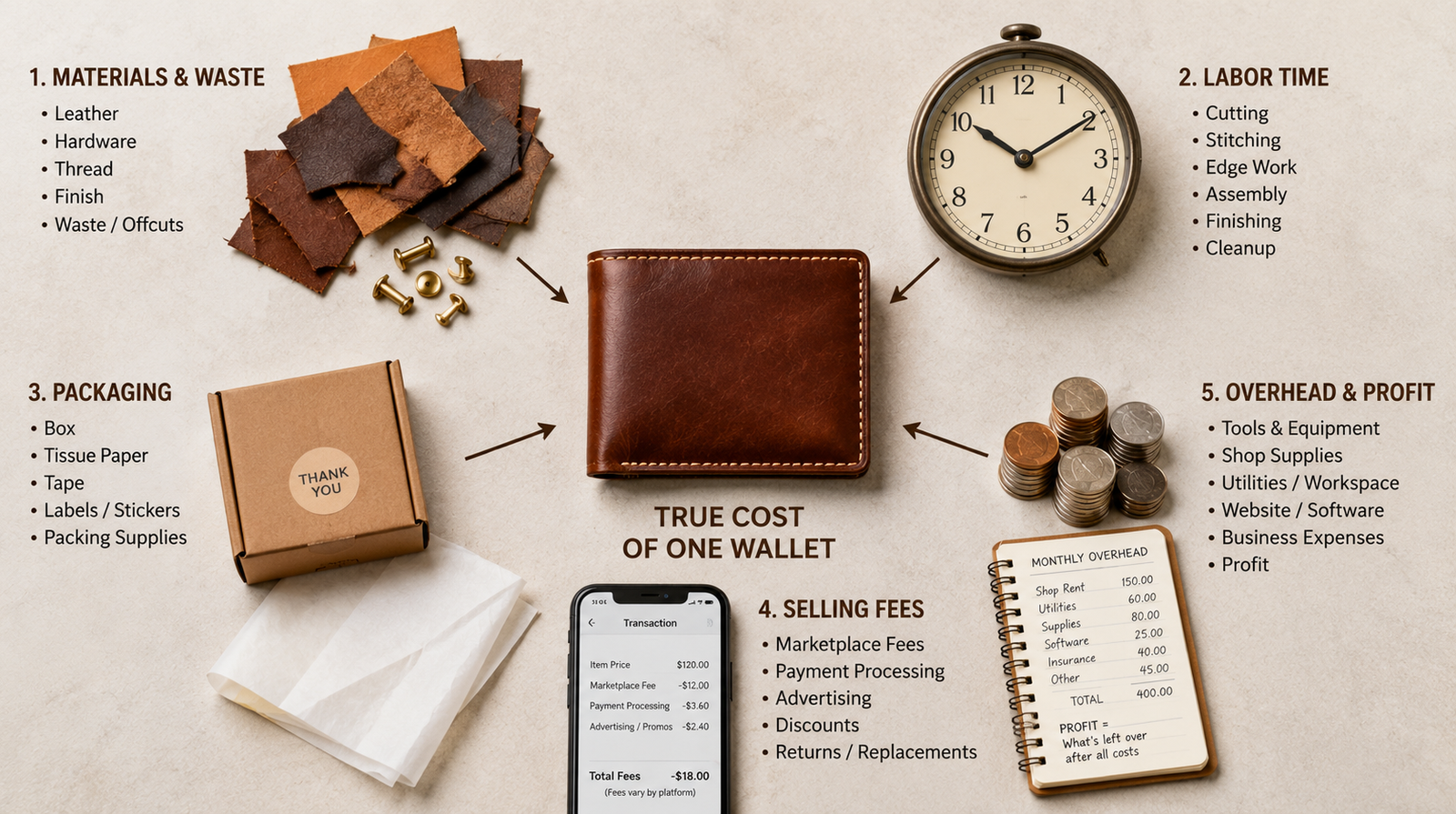
The wallet in the center is paid for by all five of these categories. Leave any one of them out of your pricing and the product is quietly losing money.
Wholesale and Retail Are Different Businesses
A wholesale order is not simply a retail order with a discount. The buyer usually expects room to resell the product, consistent specifications, dependable delivery, and enough production capacity to fill a larger order.
Before offering wholesale pricing, calculate whether the lower per-item price still covers:
- Materials and normal waste
- Production labor
- Packaging required by the buyer
- Administrative and shipping preparation time
- Overhead and profit
Larger quantities may reduce setup time and material cost, but they can also tie up cash and create weeks of repetitive production. Offer wholesale only after the retail product and production process are stable enough to support it.
Photograph the Product Honestly
Online customers cannot handle the leather, test the pockets, feel the temper, or examine the stitching in person. Your photographs have to show enough detail for them to understand what they are buying.
A modern phone can produce strong product photographs when the lighting, background, focus, and color are controlled. A clean setup is more important than an expensive camera.
Include more than one attractive angle
- A clear front view
- The back and interior
- Edges, stitching, hardware, and closures
- The item held or worn for scale
- Pockets shown with cards, cash, tools, or the intended contents
- Any natural marks or variations the customer should expect
Soft window light often works well, but any controlled light can work when it produces accurate color and avoids hard glare. Watch reflective hardware, dark leather, and glossy finishes carefully. Automatic phone processing can brighten shadows or shift color enough to make the product look different from what arrives.
Use a simple background that separates the product from the surface. Workshop tools can add context, but they should not compete with the item being sold.
Bench note: A beautiful photograph should still be an honest photograph. Do not edit out scars, color variation, edge irregularities, or other details the customer will see when opening the package.
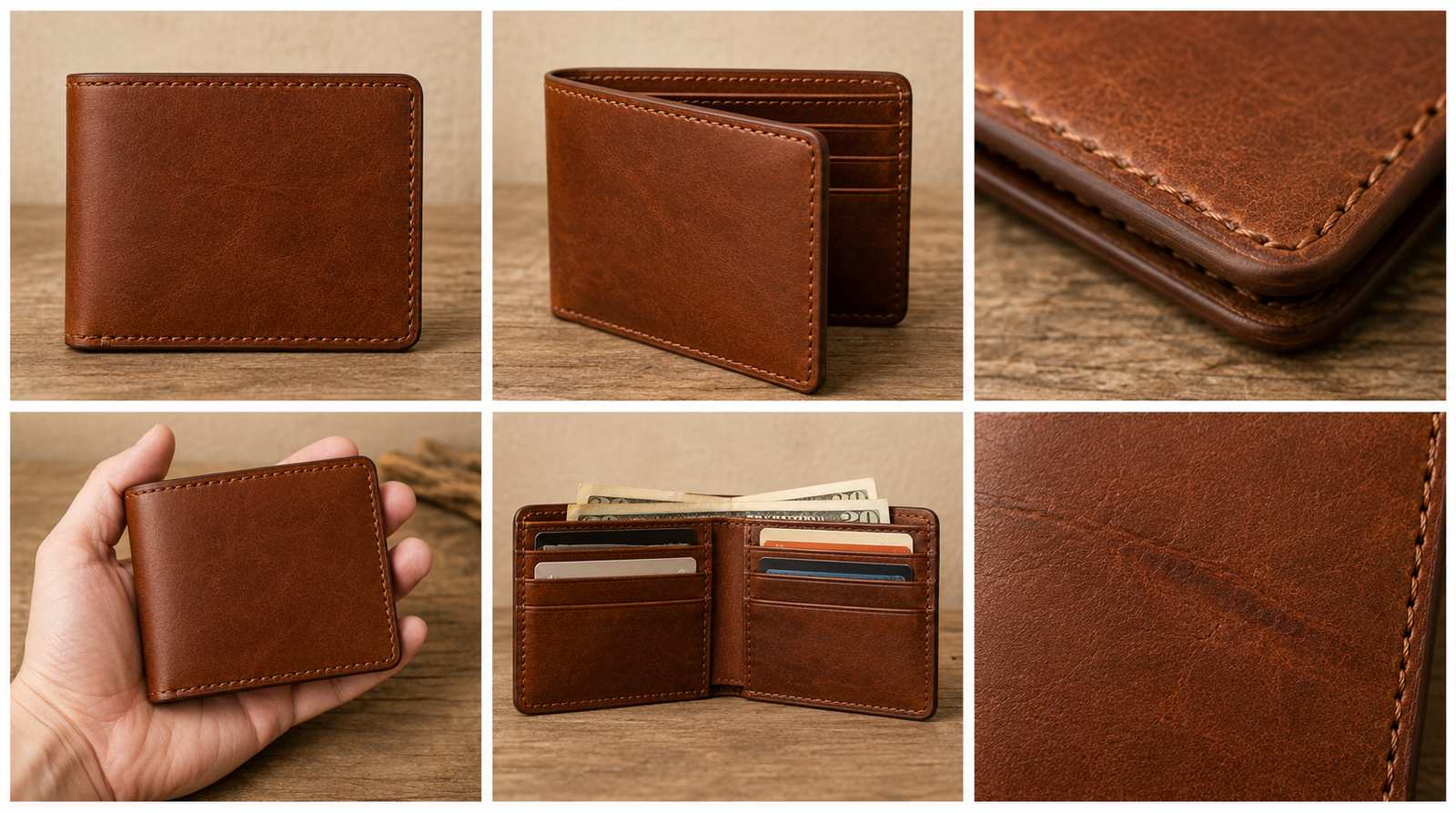
Six photographs, one product. Front, back, edge detail, scale, capacity, and material variation. A complete listing gives the buyer enough information to make a confident decision.
Write Listings That Answer Customer Questions
A strong listing reduces uncertainty. It should tell the buyer what the product is, what it is made from, how large it is, what it holds, and what will vary from one piece to another.
Include:
- Dimensions: Give actual measurements rather than relying only on photographs.
- Materials: Name the leather, tannage, hardware, lining, and thread when those details matter.
- Capacity: Explain how many cards, tools, notebooks, or other items it is designed to carry.
- Construction: Mention hand stitching, machine stitching, rivets, edge paint, burnishing, or other meaningful features without padding the description with empty luxury language.
- Variation: Explain natural grain, pull-up, scars, patina, and color variation when they are part of the material.
- Lead time: Clearly distinguish ready-to-ship stock from made-to-order work.
- Care: Give only the maintenance advice the particular leather actually needs.
Do not make the customer guess whether a notebook cover includes the notebook, whether a belt measurement refers to the total length or the center hole, or whether the pictured color is the exact item being shipped.
The best listing copy sounds like a knowledgeable maker explaining the product across the bench.
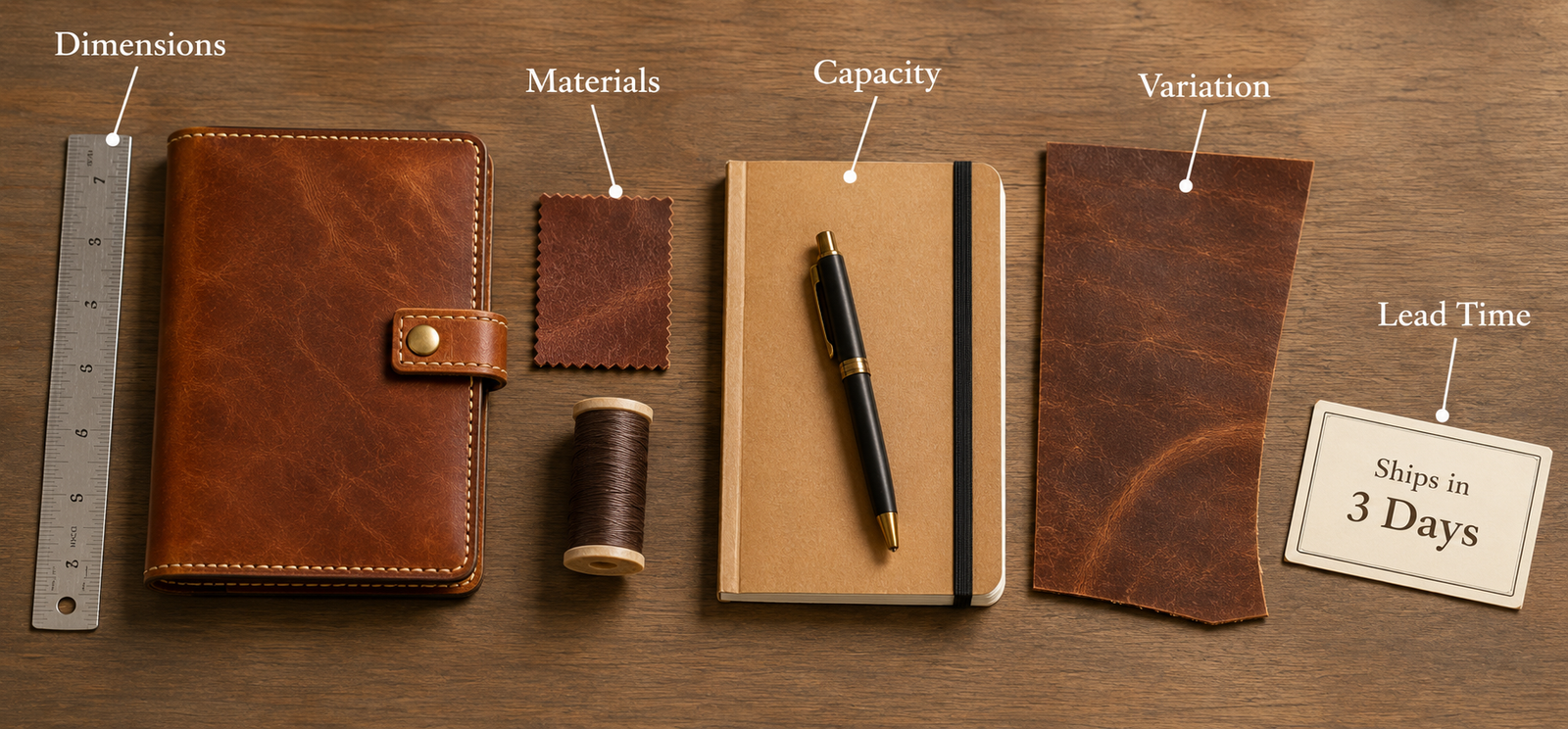
Five things every listing should answer. A buyer who has to guess about dimensions, materials, or lead time is a buyer who may not complete the purchase.
Buy Materials Without Creating Dead Stock
Buying larger quantities can reduce the cost per square foot or per piece of hardware, but only when the business can actually use those materials.
A full side may be a better value than small panels when you regularly make several products from the same leather. It can be a poor purchase when one slow-selling color sits on the shelf for two years.
Scale purchasing in stages
- Testing stage: Buy enough material to make samples, photograph the product, and fill the first few orders.
- Proven product: Increase the order when sales show that the leather, color, and hardware are moving consistently.
- Repeat production: Consider full sides, boxes, larger hardware packs, or supplier accounts when the savings justify the cash tied up in stock.
Keep records of the tannery, article, color, weight, hardware finish, supplier, purchase date, and cost. When a material works well, you need enough information to reorder the same thing.
A reliable supplier matters, but so does having a backup plan. Leather colors, tannery runs, and hardware finishes can be discontinued or temporarily unavailable. Avoid promising permanent availability unless you control enough matching stock to support the promise.
Bench note: Bulk buying lowers unit cost. It does not lower total spending, and it does not guarantee the inventory will sell.
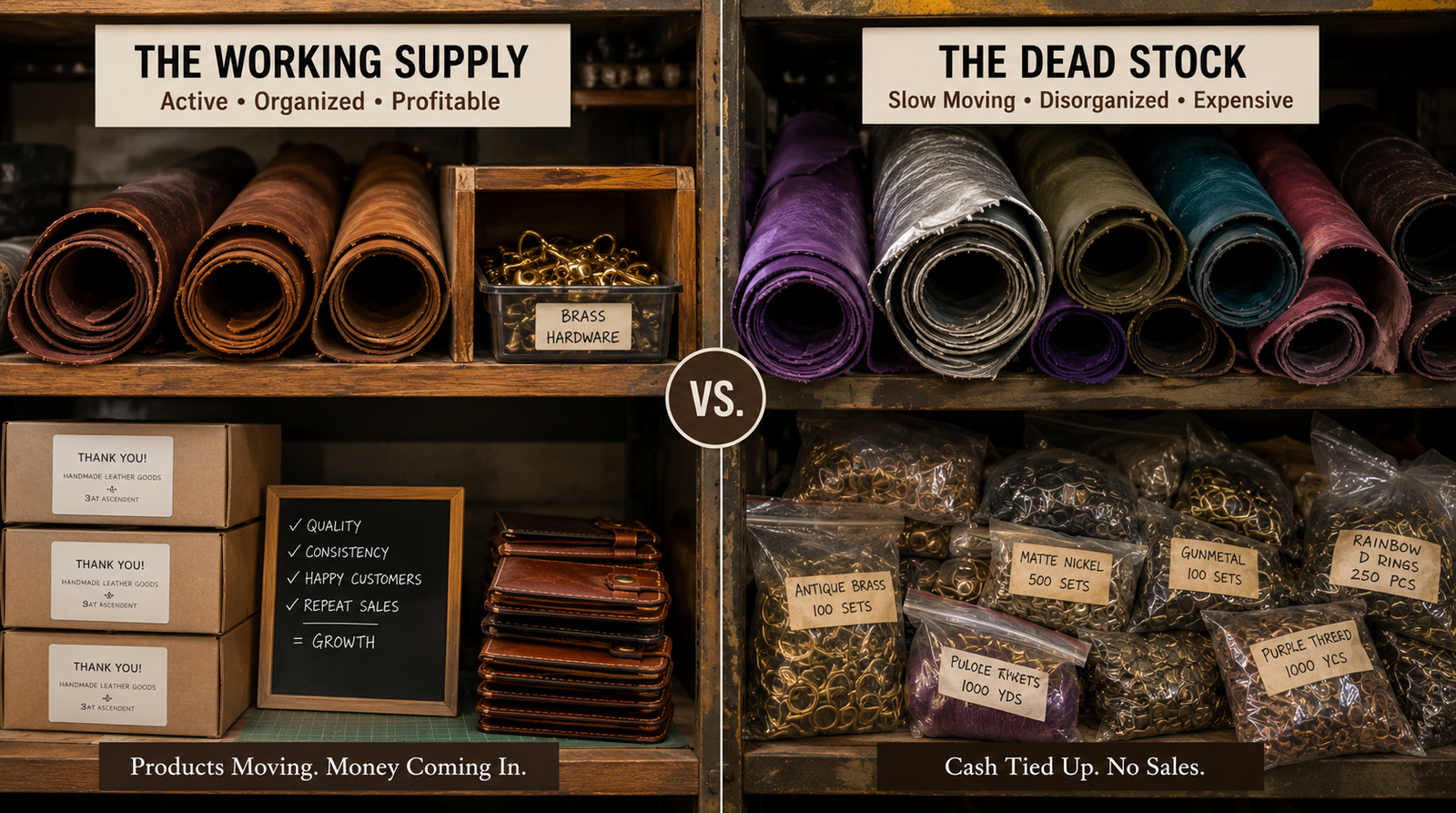
Left: products moving, money coming in. Right: cash tied up, no sales. Bulk buying lowers unit cost. It does not guarantee the inventory will sell.
Before You Open the Shop
Make the selling process once before asking a customer to trust it.
- Complete and inspect the actual product.
- Record the full production time.
- Confirm the dimensions and capacity.
- Package it and calculate the packed weight and size.
- Test the shipping method.
- Write the care instructions.
- Decide how you will handle returns, repairs, cancellations, and customization errors.
- Confirm the lead time you can meet during a busy week, not just an empty one.
Start with a manageable number of listings. A small shop with clear products and dependable delivery is stronger than a large catalog filled with items you have not fully tested.
Keep records from the first sale
Track material cost, labor time, fees, shipping, discounts, returns, and the amount actually left after the order is complete. Revenue can look impressive while the product quietly loses money.
Business registration, sales-tax duties, consumer rules, and platform requirements vary by location and selling channel. Check the requirements that apply to your business before taking orders.
Where to Source Leather and Hardware for a Small Business
The right supplier is not always the one with the lowest listed price. Compare usable yield, consistency, cut sizes, shipping, reorder availability, hardware quality, and how clearly the seller describes the material.
Small makers may need a combination of suppliers: one for dependable leather articles, another for closeouts, and a dedicated hardware source for consistent finishes and sizes.
Use our directories to compare leather selection, full hides, panels, closeouts, hardware, shipping, and supplier strengths before committing money to production inventory.