
Choosing the Right Hardware for Your Leather Project
Good leather can carry a project a long way, but the hardware still has to do its job.
A buckle has to hold tension. A rivet has to stay seated. A D-ring or snap has to handle the weight and movement the project was designed for. When one of those parts fails, it usually does not matter how clean the stitching looked.
The difficult part is that hardware listings are not always easy to compare. Two buckles may look nearly identical in a product photo while being made from very different metals. One may be solid brass. Another may be zinc alloy with a brass-colored finish. Both may work, but they may not age, wear, or carry load in the same way.
The same problem comes up with rivets and rings. Size, post length, wall thickness, weld quality, finish, and base metal all affect whether the hardware suits the project.
This guide explains the most common leather hardware materials, how tubular rivets differ from burr rivets, and what to look for when choosing buckles, D-rings, O-rings, and similar fittings.
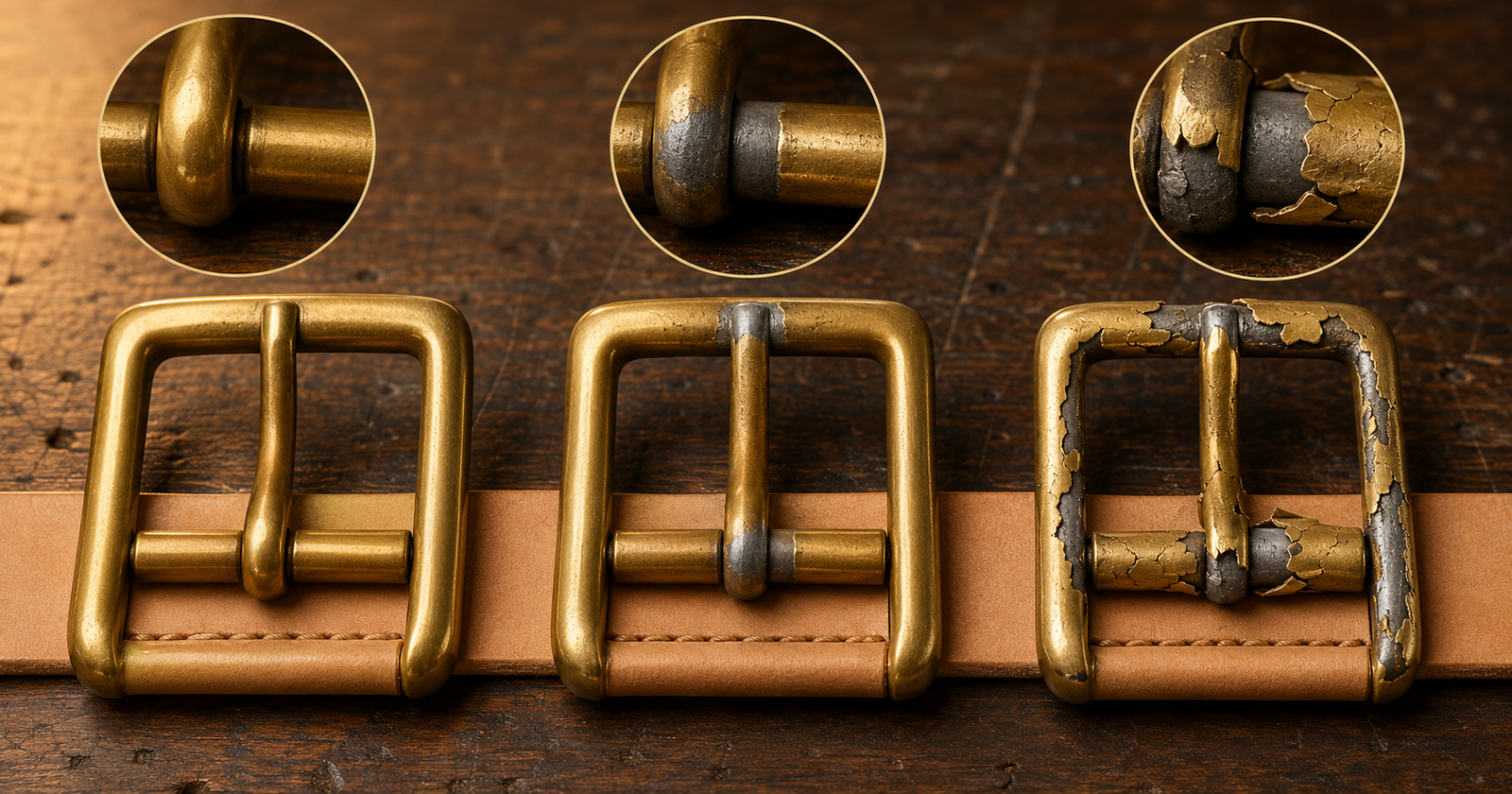
Three buckles, same shape, three different materials. The insets show what happens at the wear point over time. Solid brass stays consistent. Plated hardware reveals what is underneath.
Solid Brass, Stainless Steel, and Plated Hardware
Start with the base metal: A brass-colored buckle is not necessarily solid brass. The listing should identify what the hardware is made from, not only the finish color.
Solid brass is popular because the metal runs all the way through the piece. As the surface wears, it does not reveal a completely different base color underneath. Untreated brass can darken and develop a patina, while polished or coated brass may stay brighter for longer.
Stainless steel is another strong option, especially for outdoor gear, straps, working equipment, and projects exposed to moisture. Good stainless hardware resists corrosion and usually maintains a cleaner, more modern appearance than brass.
Plated hardware uses a base metal covered with another finish. That base may be steel, zinc alloy, brass, or another metal. Plating can provide a specific color, lower the price, or create a more uniform finish.
Plated hardware is not automatically bad. It can work well for light-duty bags, wallets, decorative straps, prototypes, costume pieces, and projects where keeping the price down matters.
The tradeoff is that the finish may eventually scratch, fade, or wear through, especially where parts rub together. If the base metal is brittle or the casting is poor, the hardware may also be less dependable under heavy load.
For belts, dog gear, saddlery, load-bearing straps, and projects intended for years of hard use, solid brass or appropriately rated stainless steel is usually worth the extra cost.

Left: solid brass. The metal is the same all the way through. Right: plated hardware. The coating is cracking away and the gray base metal underneath is showing.
Solid brass
- Ages naturally
- Can develop patina
- No plating layer to wear through
- Usually more expensive
- Can react with some leathers and leave dark marks
Stainless steel
- Strong and corrosion resistant
- Good for outdoor or wet use
- Clean silver appearance
- Usually does not develop the same warm patina as brass
Plated zinc or steel
- Lower cost
- Broad range of finishes
- Suitable for many light-duty projects
- Finish may wear or chip
- Quality varies widely
Tubular Rivets, Double-Cap Rivets, and Burr Rivets
Rivets are useful for reinforcing stress points, attaching hardware, joining thick layers, or securing areas that are difficult to stitch.
They should support the construction rather than compensate for poor design. A rivet placed too close to an edge, set through weak leather, or installed with the wrong post length can fail no matter how strong the metal is.
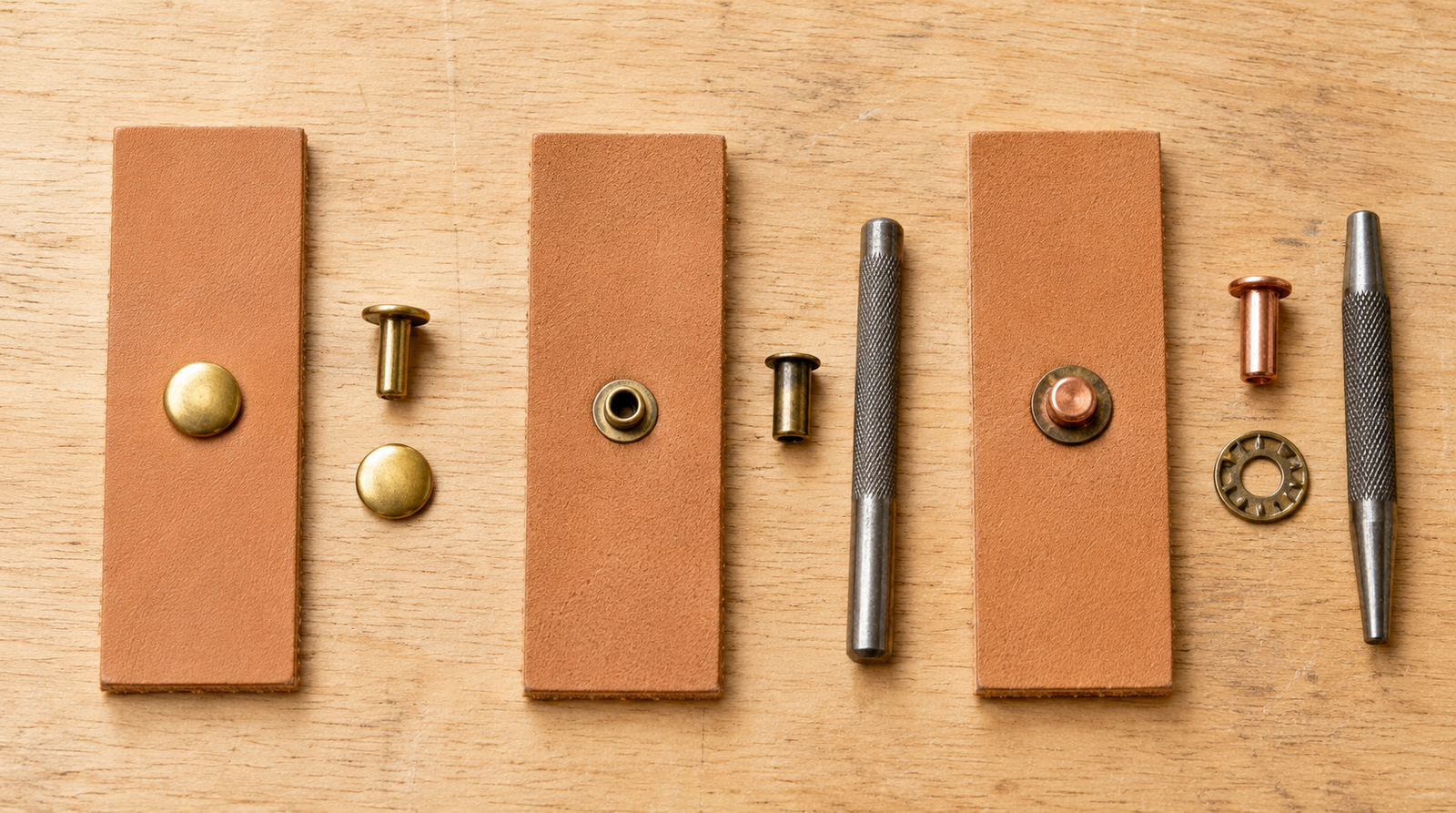
Left to right: double-cap rivet, tubular rivet, and copper burr rivet. The loose components beside each strip show how each system is constructed before installation.
Double-cap rivets
Double-cap rivets have a finished cap on both sides. They are popular for bags, wallets, straps, bracelets, and decorative work because the installed rivet looks clean from either direction.
They are best for light to medium loads unless the manufacturer specifically rates them for heavier work.
Single-cap and tubular rivets
Tubular rivets have a hollow or partially hollow post that rolls or flares when set. They are available in several sizes and can be installed with hand setters, presses, or machines.
They work well for general leathercraft, but the post length needs to match the total leather thickness. A post that is too short will not hold securely. One that is too long may bend, crush, or set crooked.
Copper or brass burr rivets
Burr rivets use a solid post and a separate washer called a burr. The burr is driven tightly onto the post, the excess is cut away, and the remaining end is peened over.
These rivets are strong, repairable, and well suited to belts, saddlery, tool gear, heavy straps, and other demanding projects.
They are not literally indestructible, and the leather around them can still tear. Their advantage is a very secure mechanical connection when the rivet is sized and installed correctly.
Post length matters as much as rivet type. Measure the combined thickness of every layer before ordering. The post needs enough extra length to set properly, but not so much that it folds over or crushes the leather.
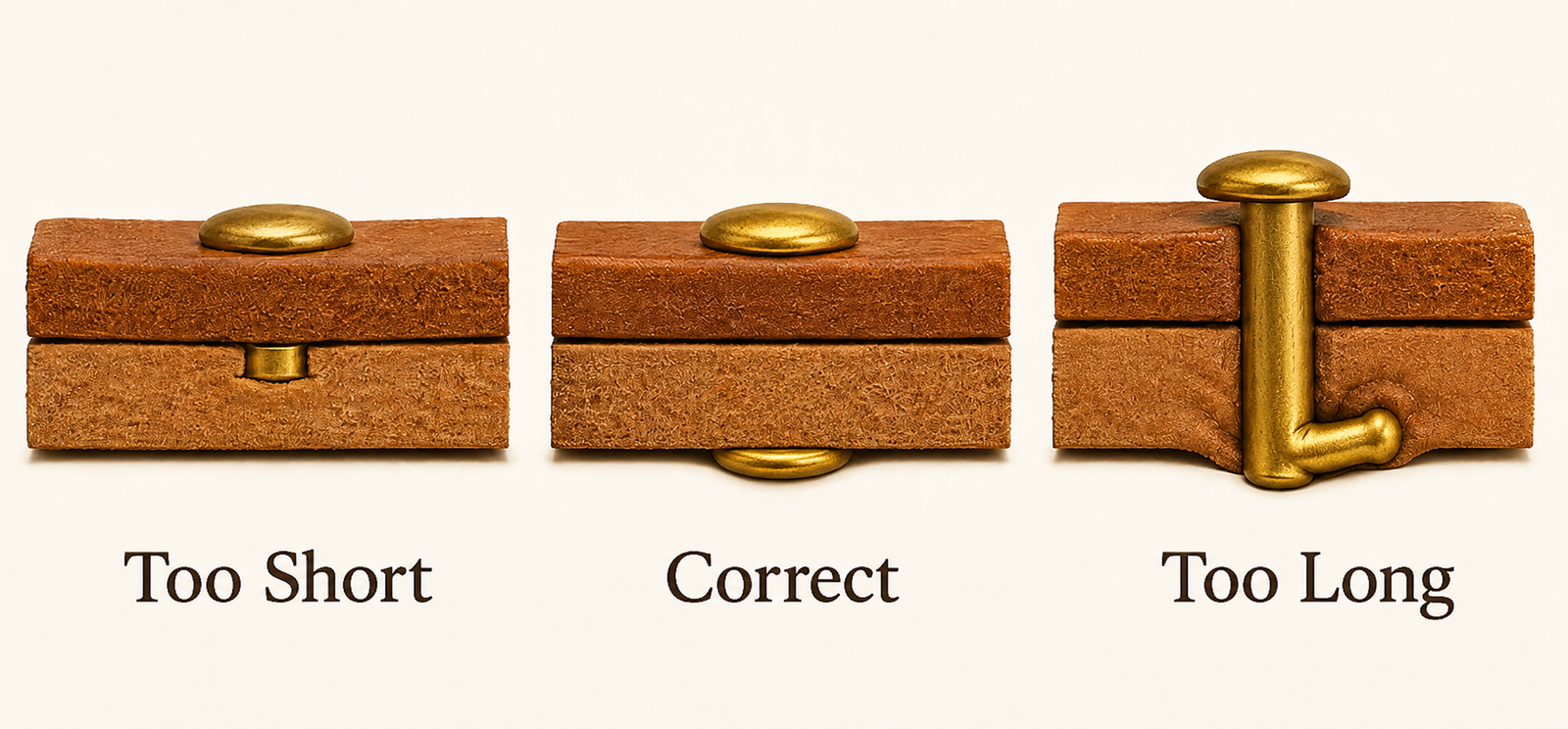
Post length determines whether the rivet holds or fails. Too short and it will not seat. Too long and it bends or crushes the leather during setting.
Buckles, D-Rings, O-Rings, and Hardware Sizing
Most leather hardware is sized by the inside width of the opening where the strap passes through.
A buckle sold as 1 inch is generally intended for a 1-inch strap. A 1.5-inch D-ring is generally meant to accept a strap close to 1.5 inches wide.
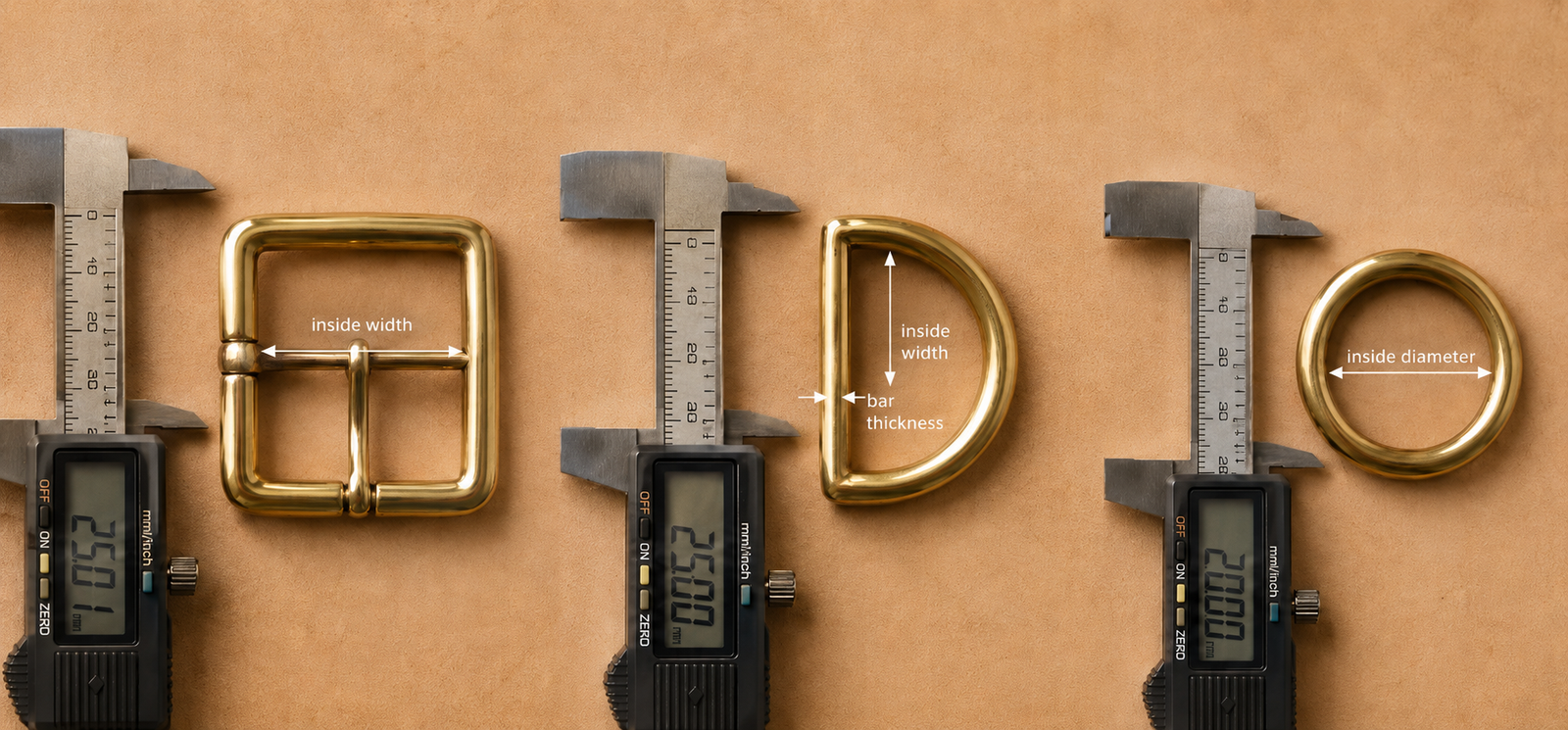
Hardware sizing explained. The listed size on a buckle or D-ring refers to the inside width, not the overall dimension. Bar thickness is a separate measurement that affects how thick a strap can fit.
Still, do not assume every supplier measures every part the same way. Some listings use inside width, some show overall dimensions, and some provide both. Check the diagram or specification sheet before cutting the strap.
The strap should fit without binding, but it should not have so much extra room that it slides around awkwardly. A slightly narrower strap may be appropriate when the leather is thick, folded, or stitched around the hardware.
For D-rings and O-rings, also look at the wire or bar thickness. Two rings can have the same inside width while being built for completely different loads.
Welded rings are usually preferred for load-bearing straps because the joint is closed. Cast or seamless rings may also be strong, depending on the material and manufacturing quality. Open wire rings are better reserved for light-duty or decorative use unless the supplier clearly rates them otherwise.
Buckles need the same kind of attention. Check the inside width, tongue length, frame thickness, and whether the leather must be skived or folded to fit cleanly around the bar.
Common Leather Hardware Buying Mistakes
Buying by color instead of base metal
“Antique brass,” “gunmetal,” “nickel,” and “rose gold” may describe the surface finish rather than the actual material. Look for the base metal in the product description.
Ordering the correct width but ignoring thickness
A 1-inch ring may fit a 1-inch strap, but a thick folded strap may bind against the frame. Check the bar thickness and available clearance.
Using a rivet post that is too long
Extra post length does not create extra strength. A post that is too long is more likely to bend, lean, or crush the leather during setting.
Punching hardware holes too close to the edge
Strong hardware cannot protect weak leather. Leave enough material around rivet holes, buckle slots, and snap installations to carry the expected load.
Mixing finishes without checking them together
One supplier’s antique brass may be brown, while another supplier’s version looks nearly black. Buy samples or compare pieces in person when matching hardware matters.
Ignoring hardware weight
Heavy solid brass can make a small bag feel unbalanced. Lightweight hardware may be better for compact goods even when the more expensive option is stronger.
Where to Buy Quality Leather Hardware
Better hardware is easiest to find through suppliers that clearly list the base metal, finish, dimensions, and intended use.
General craft stores can be useful for inexpensive practice pieces, but dedicated leathercraft, bag-making, marine, equestrian, and saddlery suppliers usually provide more useful specifications and a wider range of sizes.
Our hardware supplier directory covers buckles, rivets, snaps, rings, clasps, findings, strap hardware, and other metal components. Buckleguy is my first recommendation for solid brass and stainless hardware in North America. The full directory includes additional options for specialty hardware, international sourcing, and budget-friendly suppliers for practice work.