
Natural Brain Supplements Without the Guesswork
A practical look at popular nootropic herbs, standardized plant extracts, and one clean-label formula designed to make natural cognitive support easier to use consistently.
There is something appealing about getting your health support directly from nature. You know what you are using, you can learn where it came from, and you are not swallowing a capsule filled with ingredients you cannot pronounce.
For some people, that means growing herbs, cultivating mushrooms, buying loose plant material, or preparing their own teas and tinctures. For others, it simply means choosing supplements built around recognizable natural compounds instead of stimulants and complicated synthetic blends.
The difficulty is not usually finding a list of herbs associated with memory, focus, stress, or mental energy. There are thousands of those lists online. The harder questions are much more practical:
Are you using the right part of the plant? Is the extract strong enough? Are you getting a useful amount? Can you take the same amount consistently from one day to the next?
That is where the difference between a plant and a finished supplement begins to matter.
In this guide, we are going to look at several of the best-known natural nootropics, what people use them for, and why standardized extracts have become a practical middle ground between traditional herbal preparation and modern supplementation.
We will then examine Mind Lab Pro, a caffeine-free natural nootropic formula that combines several of these ingredients in one product. The goal is not to convince you that growing or preparing herbs is wrong. It is to help you decide whether doing everything yourself, buying several separate extracts, or using one combined formula makes the most sense for your routine.
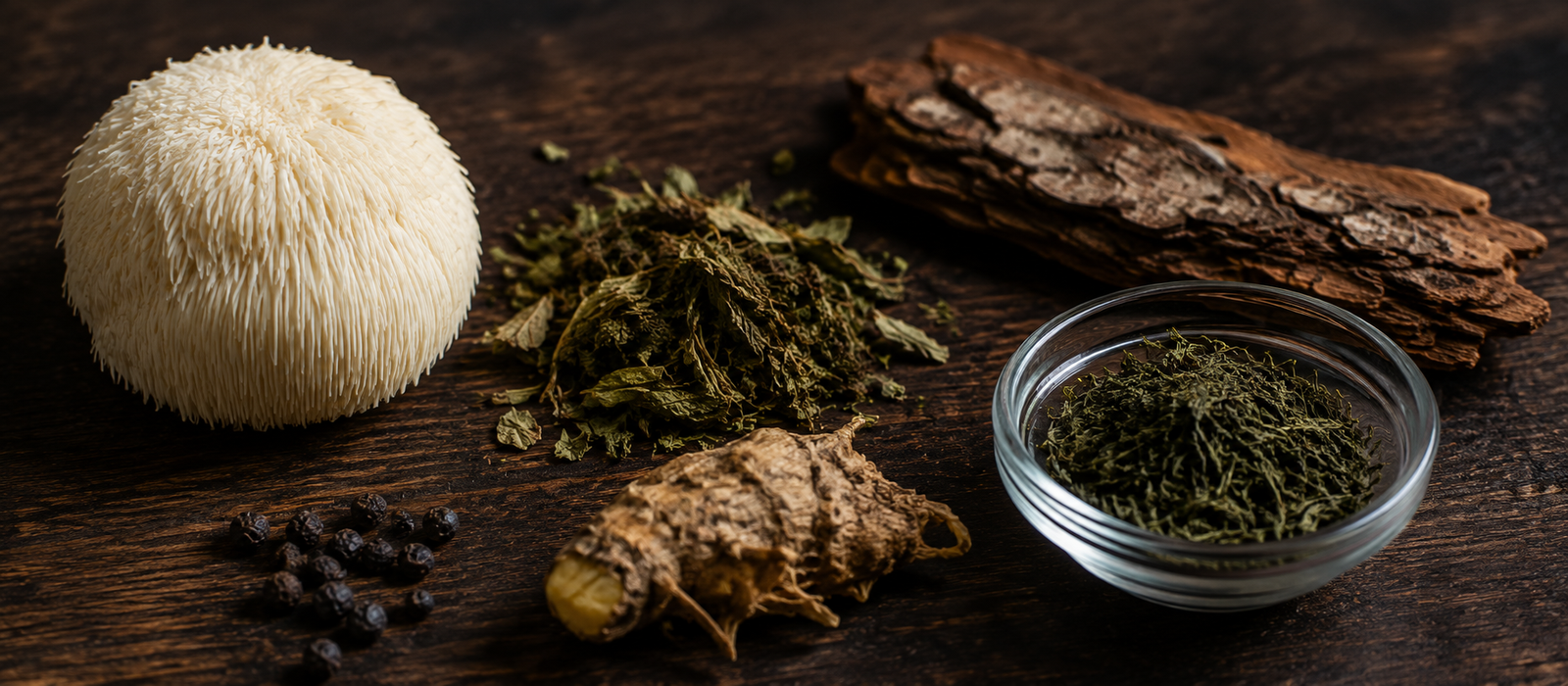
Natural Nootropic Herbs for Memory, Focus, and Mental Clarity
“Natural” can mean many things in the supplement world. Sometimes it refers to a whole herb. Sometimes it means a concentrated extract. It may also describe an amino acid or nutrient that occurs naturally in food or in the body.
That distinction is important because a handful of plant material is not necessarily equivalent to the standardized extract used in a study or listed on a supplement label.
The following ingredients are among the better-known natural compounds used in supplements for memory, focus, mental energy, calm concentration, and stress support. They do not all work in the same way, and the quality of the evidence is not identical for each one. Still, they provide a useful picture of what people are looking for when they search for natural brain supplements.
Lion’s Mane is one of the most recognizable mushrooms in the natural nootropic market. It contains compounds known as hericenones and erinacines, which have attracted interest for their possible relationship with nerve growth factor. People commonly use Lion’s Mane for memory, mental clarity, mood, and long-term brain support. Product quality can vary depending on whether the supplement uses the fruiting body, mycelium, or a combination of both.
Bacopa has a long history in Ayurvedic practice and is now commonly included in supplements for learning and memory. Its best-known active compounds are called bacosides. Unlike a stimulant that someone may notice quickly, Bacopa is generally used consistently over a period of weeks. When comparing products, the amount of Bacopa matters, but so does the percentage of bacosides in the extract.
Rhodiola is an adaptogenic root traditionally associated with physical endurance, mental fatigue, and performance during stressful periods. The root naturally contains compounds called rosavins and salidrosides. Standardized Rhodiola extracts usually identify the concentration of those compounds, which makes them easier to compare than unmeasured root powders or homemade preparations.
Maritime pine bark contains antioxidant compounds called proanthocyanidins. These extracts are often included in brain health formulas for their relationship with circulation, oxidative stress, and the delivery of oxygen and nutrients throughout the body. This is one of the clearer examples of why extraction matters. A measured pine bark extract is very different from simply consuming raw bark.
L-Theanine is an amino acid naturally found in tea leaves, especially green tea. Many people use it for calm concentration because it is not a traditional stimulant. Drinking tea can provide L-Theanine, but the amount varies with the type of tea and the way it is brewed. A supplement provides a measured amount without requiring several cups of tea or adding more caffeine.
Ashwagandha is another well-known adaptogen from Ayurvedic practice. It is used more often for stress support than for direct stimulation or immediate focus. That distinction matters. For someone whose concentration suffers when stress and mental overload build up, supporting the stress response may indirectly make it easier to think clearly and stay on task.
“Choosing the right herb is only part of the job. The form, strength, preparation, and daily amount can make the difference between taking something that sounds promising and following a routine you can actually evaluate.”
Whole Herbs, Teas, Powders, or Extracts: What Is Practical Every Day?
Preparing your own herbs can be enjoyable and worthwhile. Some people like growing medicinal plants. Others buy loose herbs, mushroom powders, or individual tinctures because they want more control over what they use.
There is nothing inherently inferior about that approach.
The question is whether it fits what you are trying to accomplish. Making an occasional cup of herbal tea is one thing. Building a daily natural nootropic routine around several plants, mushrooms, amino acids, and nutrients is something else.
Once you begin looking for consistent amounts of specific active compounds, the process becomes more complicated.
Five Challenges of Building a DIY Nootropic Routine
-
1Not every ingredient is practical to grow or prepare at home. Rhodiola prefers cold mountainous regions. Bacopa is a wetland plant. Lion’s Mane is a mushroom rather than a garden herb. Maritime pine bark is not something most people are going to harvest and process themselves.
Even when home cultivation is possible, recreating the growing conditions associated with a particular plant can take more time, space, and experimentation than expected. -
2The useful portion of a plant may be very specific. The root, bark, leaf, fruiting body, or mycelium may contain different compounds in different amounts. Harvest time, growing conditions, storage, and processing can also affect the finished material.
That does not make homegrown herbs worthless. It means two batches that look similar may not be chemically identical. -
3Preparation methods change what you actually consume. Tea, powder, tincture, and concentrated extract are not interchangeable.
Some compounds dissolve well in water. Others require a different extraction process. Heat, drying, storage, steeping time, and the amount of raw material used can all influence the final preparation.
A pleasant herbal tea may still be useful as part of someone’s routine, but it should not automatically be treated as equivalent to a measured extract. -
4A household serving is difficult to measure precisely. This is where many natural supplement routines become confusing.
A spoonful, handful, scoop, or cup tells you how much material was used. It does not necessarily tell you how much of a particular active compound was present.
A standardized extract gives the buyer more information. For example, a label may identify both the weight of the Bacopa extract and the percentage of bacosides it contains. That does not guarantee a particular result, but it makes the product easier to measure, compare, and use consistently. -
5A complicated routine is harder to maintain. Many people begin with several bottles, powders, teas, and carefully timed ingredients. Then ordinary life takes over.
A routine only helps when it is realistic enough to continue. For some people, separate ingredients provide the control they want. For others, combining several natural nootropics into one formula is worth paying for because it removes several daily decisions.
None of this means that loose herbs, teas, tinctures, or homegrown plants should be abandoned. They may be exactly what you want.
It simply helps to separate two different goals.
One goal is enjoying the plant, the preparation, and the traditional practice surrounding it. The other is getting a repeatable amount of several specific compounds as part of a daily cognitive supplement routine.
Those goals can overlap, but they are not always the same.

Where Standardized Natural Supplements Fit In
Standardized extracts are the middle ground between raw plant material and a completely synthetic approach.
The original source may still be a mushroom, root, leaf, bark, or tea plant. The difference is that the material has been processed so the manufacturer can identify and repeat a particular strength or concentration.
That makes several things easier for the buyer:
You can read the amount on the label. You can compare one formula with another. You can take roughly the same serving each day. You can also avoid purchasing, preparing, and tracking every ingredient separately.
This does not automatically make every manufactured supplement good. A capsule can still be underdosed, poorly formulated, unnecessarily complicated, or filled with ingredients that add more marketing than value.
The advantage is not simply that it comes in a bottle. The advantage is that a well-labeled formula gives you a clearer idea of what you are taking and how much of it is included.
That is the standard we used when looking at Mind Lab Pro.
Mind Lab Pro v4 Review: A Combined Natural Nootropic Formula
Eleven natural nootropics and supporting nutrients in a caffeine-free, clearly labeled formula.
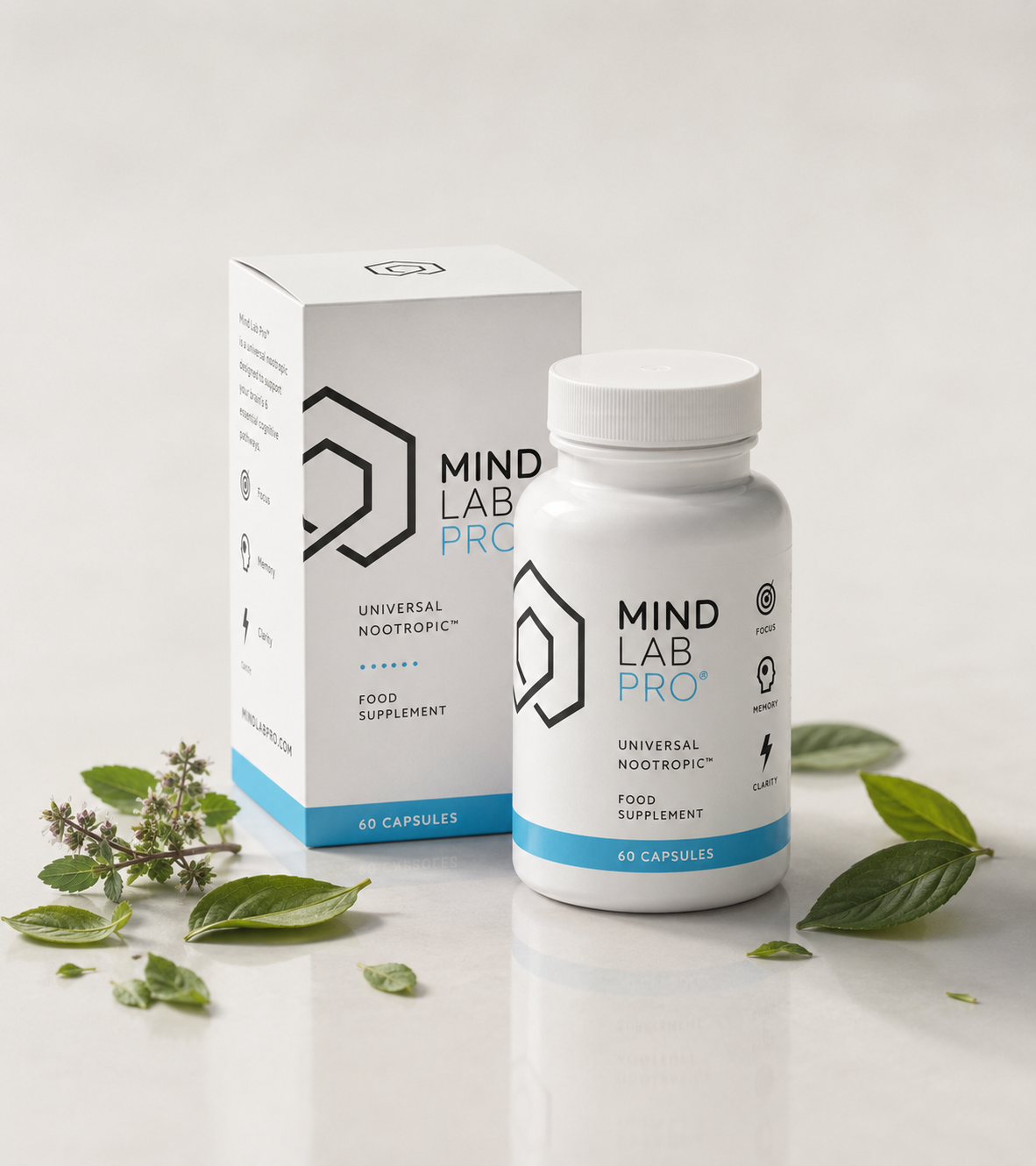
Mind Lab Pro is built for the person who likes the idea of natural cognitive support but does not want to assemble a routine from several separate bottles.
The formula includes some of the ingredients discussed above, including Lion’s Mane, Bacopa Monnieri, Rhodiola Rosea, maritime pine bark, and L-Theanine. It also includes citicoline, phosphatidylserine, N-acetyl-L-tyrosine, and three B vitamins.
That combination gives the product a broader purpose than a single-ingredient supplement. Rather than focusing only on memory, energy, or stress, the formula is positioned as general daily cognitive support.
The ingredient label is one of its stronger features. Each ingredient is identified with an individual amount rather than being hidden inside a proprietary blend. Several of the plant extracts also state the form or standardization used, which makes it easier to understand what is actually in the capsules.
Mind Lab Pro is also caffeine-free. That will matter to people who want help with concentration but do not want another stimulant added to their day.
None of this means that every user will notice the same benefit, or that combining eleven ingredients automatically makes a product superior. It does mean that Mind Lab Pro offers a convenient and unusually transparent way to try several widely used natural nootropics in one routine.
How the Formula Looks on Paper
These scores reflect our assessment of the published ingredient label, formula design, ease of use, and listed pricing. They are not a guarantee of individual results.
What the Product Research Reported
Mind Lab Pro’s manufacturer highlights human studies conducted on the complete formula rather than relying only on research involving its individual ingredients.
That is worth paying attention to. Many supplement companies cite research on separate ingredients even when their finished product has never been studied as a whole.
The reported studies evaluated areas such as information processing and memory performance. The manufacturer summarizes the results with the figures shown below.
These percentages should be read as reported study outcomes under specific testing conditions, not as a promise that every customer will experience the same degree of improvement. Study size, participant characteristics, duration, testing methods, and other limitations all affect how broadly results should be interpreted.
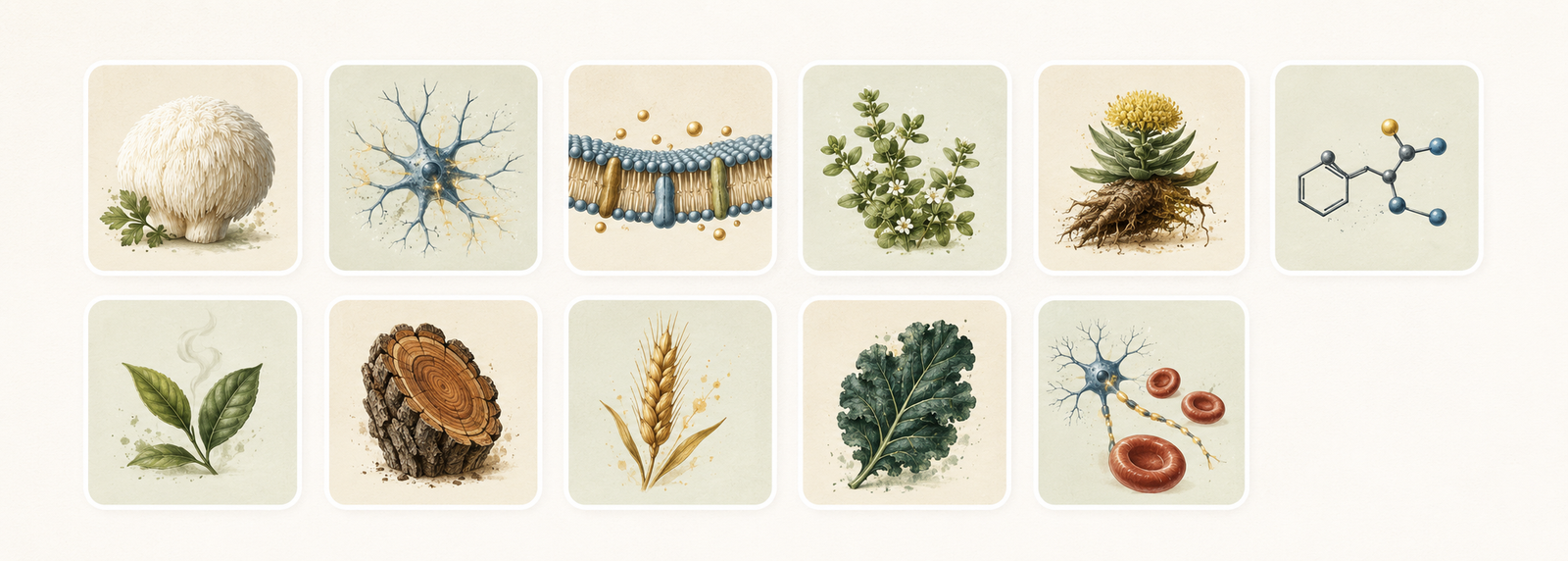
Mind Lab Pro Ingredients and Amounts
The formula contains eleven listed ingredients in a two-capsule serving. The label does not use a proprietary blend, so the amount of each ingredient is available for buyers to review.
That transparency makes it easier to compare Mind Lab Pro with separate supplements or competing nootropic formulas.
The table below reflects the formula information we collected from the manufacturer. The amounts and branded ingredient forms should be checked against the current product label before publication.
| Ingredient | Dose | Form / Standard | Primary Benefits |
|---|---|---|---|
| Organic Lion’s Mane Mushroom | 500 mg | Mycelium + Fruit body | Nerve Growth SupportMemory SupportMood Support |
| Citicoline | 250 mg | As Cognizin® | Brain EnergyFocusCell Repair |
| Phosphatidylserine (PS) | 100 mg | Sunflower lecithin (soy-free) | MemoryMoodHealthy Cognitive Aging |
| Bacopa Monnieri | 150 mg | Full spectrum, 24% bacosides, 9 bioactives | LearningRecallAntioxidant |
| Rhodiola Rosea | 50 mg | 3% rosavins, 1% salidrosides (root) | Stress ResilienceMoodMental Energy |
| N-Acetyl-L-Tyrosine | 175 mg | Acetylated form of L-Tyrosine | Stress PerformanceMultitaskingDecision Making |
| Maritime Pine Bark Extract | 75 mg | 95% proanthocyanidins | Blood FlowAntioxidantBrain Energy |
| L-Theanine | 100 mg | Pure amino acid | Alpha BrainwavesFlow StateCalm Focus |
| Vitamin B6 | 2.5 mg | NutriGenesis® (clean-cultured) | MoodBlood Flow |
| Vitamin B9 (Folate) | 100 mcg | NutriGenesis® (clean-cultured) | Brain Cell EnergyCognition |
| Vitamin B12 | 7.5 mcg | NutriGenesis® (clean-cultured) | Nervous System SupportMood |
Capsule: NutriCaps® Pullulan (fermented tapioca) • Flow agent: Nu-FLOW® Rice Concentrate. No synthetic fillers.
What Is Not Included in the Formula
People searching for clean-label supplements are often just as concerned about the inactive ingredients as they are about the featured nootropics.
According to the manufacturer’s current product information, Mind Lab Pro is made without caffeine, synthetic additives, common allergens, or proprietary blends. It also uses plant-based capsules.
That makes the formula easier to consider for people who want to avoid stimulants or who prefer a relatively simple supplement label.
The certifications and manufacturing statements shown below should be verified against the current manufacturer page and product packaging before the page goes live.
Experiences Shared by Mind Lab Pro Users
Customer experiences can help show why different people choose a supplement, but they should not be treated as clinical evidence. The examples below were selected from material published by the manufacturer and represent individual experiences.
“Taking Mind Lab Pro for only a month improves your ability to make decisions, your ability to anticipate, and it also improves memory. Particularly immediate recall and delayed recall.”
“I was struggling with brain fog with the arrival of perimenopause. I introduced Mind Lab Pro and immediately noticed a difference. I feel switched on, no brain fog, and can perform at the level I need to be at.”
“MLP is awesome. It makes it easy to get all the best nootropics into my daily diet. The long-term benefits are undeniable. Think of it as a multivitamin for the brain.”
Mind Lab Pro Price and Buying Options
Mind Lab Pro is sold through the manufacturer’s website. Buying directly may help customers avoid outdated inventory or unauthorized sellers, while also preserving any guarantee or subscription terms offered by the company.
This is not one of the least expensive natural brain supplements. Part of what you are paying for is the convenience of combining several ingredients into one formula.
Someone who only wants Lion’s Mane, Bacopa, or L-Theanine may spend less by purchasing a single-ingredient product. Someone who already buys several of the included ingredients separately may find the combined formula easier to manage and reasonably competitive.
The table below shows the pricing available when this review was prepared. We verify every price, discount, serving estimate, shipping statement, and subscription term immediately before publication because these offers can change.
| Option | Price | Per Serving | Best For |
|---|---|---|---|
| One-Time Purchase | $69.00 / bottle | $2.30 / day | Trying one bottle before committing |
| Monthly Subscription | $62.10 / month (10% off) | $2.07 / day | People who prefer recurring delivery |
| Smart Subscription (4-bottle) | $207.00 / 4 months (25% off) | $1.72 / day | Lower cost per bottle when available |
Our Verdict: A Practical Natural Nootropic for the Right Buyer
Mind Lab Pro makes the most sense for someone who wants a broad natural nootropic formula without building a daily routine from several different products.
Its strongest qualities are convenience, label transparency, the absence of caffeine, and the use of identified ingredient forms and amounts. It also includes several of the better-known natural compounds people search for when looking for support with memory, focus, calm concentration, mental energy, and stress resilience.
The connection between mental and physical performance reaches well beyond the office or classroom. We also explore that side of the conversation in our YouTube Professional Series on Fitness, where we look at athletes and fitness professionals whose work depends on focus, consistency, recovery, and performing under pressure.
That does not mean it is the right choice for everyone.
The price may be difficult to justify for someone who only wants one or two ingredients. People who enjoy preparing their own herbs or who prefer complete control over individual doses may also be happier assembling their own routine.
There is also no supplement that can replace sleep, nutrition, physical activity, medical care, or treatment for an underlying cause of fatigue, memory trouble, or difficulty concentrating.
For the person who has already decided that a combined natural brain supplement fits their needs, Mind Lab Pro presents a thoughtful and clearly labeled option. It brings several plant extracts, amino acids, phospholipids, and supporting nutrients together without relying on caffeine or an undisclosed proprietary blend.
Our recommendation is positive, but measured: review the ingredient list, consider the cost, check for medication or health-related concerns, and decide whether the convenience of one combined formula is worth more to you than buying the ingredients separately.
Who Mind Lab Pro May Be Best For
Best for
- People looking for a caffeine-free natural nootropic
- Buyers who prefer one combined formula over several bottles
- People who value clearly listed ingredient amounts
- Professionals, students, or older adults comparing daily cognitive supplements
- Buyers willing to pay more for convenience
May not be the best fit for
- Someone who wants only one specific nootropic ingredient
- Buyers looking for the lowest-cost option
- People who prefer to adjust every ingredient separately
- Anyone expecting an immediate stimulant-like effect
- Anyone advised by a healthcare professional to avoid one of the ingredients
Want a Simpler Way to Try Natural Nootropics?
Mind Lab Pro combines eleven clearly listed nootropics and supporting nutrients in one caffeine-free formula. Review the current ingredients, pricing, and purchase options directly from the manufacturer.
View Mind Lab Pro Ingredients and Current Price →Affiliate link. Product pricing, discounts, shipping, and guarantee terms may change. Review the manufacturer’s current terms before purchasing.
Affiliate Disclosure: This page contains affiliate links. If you make a purchase after following one of these links, we may receive a commission at no additional cost to you. That relationship helps support this website. We aim to evaluate products based on their ingredients, labeling, practicality, price, and available supporting information, whether or not a commission is offered.
Health Disclaimer: This article is provided for general educational purposes and is not medical advice. Supplements can cause side effects and may interact with medications or medical conditions. Speak with a qualified healthcare professional before beginning a new supplement, especially if you take prescription medication, have an existing health condition, are pregnant or nursing, or are preparing for surgery. Seek medical evaluation for new or worsening memory problems, persistent brain fog, severe fatigue, or other concerning symptoms.
© 2026 All rights reserved. Individual results may vary.